 NovaPep
Bacteriostatic Water
From $9
Research use only. NovaPep supplies research-grade peptides for laboratory and in-vitro work only, not for human or veterinary use. By continuing you confirm you are 18 or older and ordering for research.
 NovaPep
In stock in Australia, batch certificate ready
Size: 3 mL
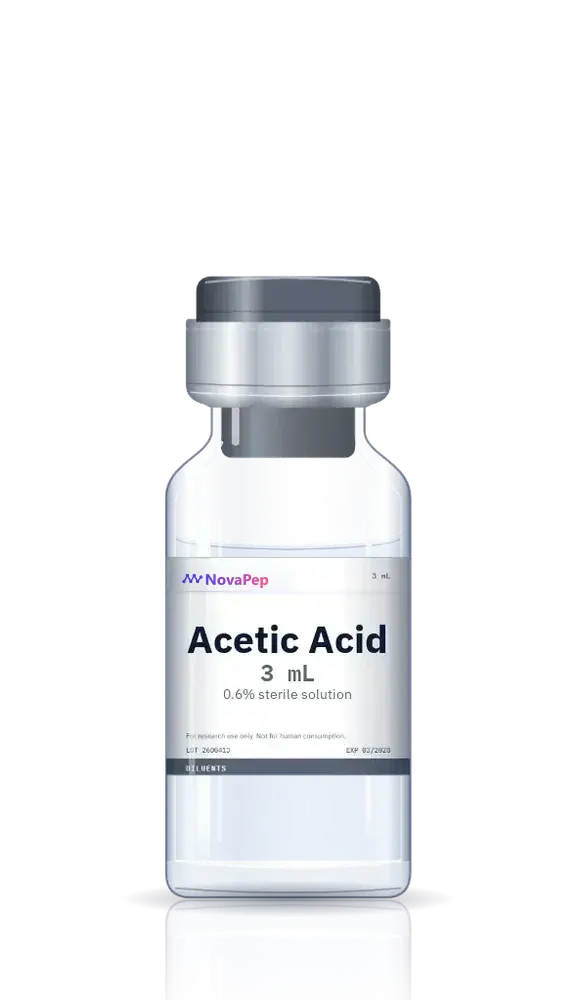
Buy acetic acid for peptides online in Australia as a sterile 3 mL vial of 0.6% solution, made for dissolving hard-to-solubilise research peptides. Acetic acid for peptides is a sterile 0.6% solution of acetic acid (CH3COOH, 60.05 g/mol, CAS 64-19-7) in sterile water, about 0.1 M with a pH of roughly 2.9. Data sheets call for this mild acidic solvent whenever a peptide clumps or only half dissolves at neutral pH, because the lower pH gives the chains a shared charge so they stay apart. In our range the leading example is IGF-1 LR3, so most buyers add an acid vial to the same cart as that peptide. It comes in a 3 mL glass vial from our Australian online store, labelled with strength, volume, lot number and expiry. Use the peptide calculator to find the concentration for whatever volume you add, and grab bacteriostatic water too if your method dilutes the acidic stock later. Store the unopened vial at room temperature, out of heat and light. Sold for laboratory research to customers aged 18 or older.
For laboratory research use only. Not for human or veterinary use. Not TGA approved. See the NovaPep research use policy.
Put simply, 0.6% acetic acid is a mild sterile acid solution. It is the same chemical that makes vinegar taste sour, only much more dilute and prepared for the lab. Researchers reach for it when a peptide refuses to dissolve cleanly in ordinary water. The acid shifts the charge carried by the peptide, and that change is what allows the powder to enter solution. Buy 0.6% acetic acid online in Australia as a sterile 3 mL vial, ready to ship from local stock.
At 0.6% the solution holds roughly 6 grams of acid in each litre, close to 0.1 molar, so any protocol requesting 0.1 M acetic acid is calling for this exact strength. The pH sits close to 2.9. The vial holds sterile water with 0.6% acetic acid and nothing else, no preservative and no buffer salts. It smells faintly of vinegar when the stopper is pierced.
The majority of lyophilised peptides dissolve directly in neutral bacteriostatic water. A small number do not. Bigger chains loaded with hydrophobic or charged residues may turn into a cloudy suspension or leave flakes stuck to the glass.
Each peptide has an isoelectric point, the pH where its negative and positive charges balance exactly. At that pH nothing drives the chains apart, so they cling together and drop out of solution. The result is the hazy liquid or glassy film researchers often grumble about.
Shift the pH a good distance from that point and every chain carries a net charge of the same sign, so they repel and remain dissolved. For peptides with an isoelectric point close to neutral or above it, a gently acidic solvent achieves this. Dropping the pH lets acidic side chains accept protons, which gives the peptide a larger net positive charge.
The fact that acetic acid is weak is precisely why it works well here. With a pKa of 4.76, only slightly more than 1 per cent of its molecules give up a proton in a 0.1 M solution. The pH drops enough to protonate the free C-terminus and side chains. It stays far from the aggressive conditions that could begin breaking peptide bonds.
It is volatile as well, and many purified peptides already carry acetate as their counterion from the final salt exchange. Nothing chemically unfamiliar enters the vial, and being both weak and dilute, the acid leaves the sequence untouched.
In practice the clue is visual. A peptide that should dissolve but leaves a hazy suspension, floating flakes or a glassy film on the glass is often sitting near its isoelectric point. Larger chains rich in hydrophobic or charged residues are the usual culprits. Check the data sheet before reaching for the acid, since most peptides in our range need nothing more than neutral water.
The main research use is IGF-1 LR3, an 83-residue analogue of insulin-like growth factor 1 (9117.6 g/mol). Its data sheets usually name 0.1 M acetic acid for preparing the stock. A small group of research peptides, led by IGF-1 LR3, specify a low-pH solvent like this on their data sheets. Some data sheets list 10 mM hydrochloric acid as another acidic solvent option for IGF-1 analogues. That is a different reagent altogether, and this vial holds acetic acid only. For this kind of in vitro work, buy 0.6% acetic acid online in Australia in the same order as the peptide it will dissolve.
Where labs most often go wrong is the stage after dissolving, not the dissolving itself. Bringing an acidic stock back toward neutral forces the peptide to cross its isoelectric point a second time. If that is done slowly or at high concentration, the peptide may precipitate along the way.
Our recommendation is to add the acidic stock in one go to a large volume of well-buffered diluent or medium while mixing gently. Avoid titrating with base or trickling buffer into the stock bit by bit. Diluting tenfold or more into buffer generally moves the peptide through the risky range before it can aggregate. The earlier stages are set out in our reconstitution walkthrough. Not every assay tolerates low pH, so only use the acid where your method specifies it.
A two-step method has two goals. The acid stage gets the peptide fully into solution at a known concentration. The dilution stage moves it into the buffer or medium your assay needs, quickly enough that it does not aggregate on the way. Record the volumes for both stages and the diluent lot, so the final working concentration can be traced back later.
| Product | Acetic acid 0.6% sterile solution |
|---|---|
| Size | 3 mL vial |
| Makeup | Acetic acid diluted with sterile water to 0.6%, roughly 6 g per litre |
| Active ingredient | Acetic acid, CH3COOH, 60.05 g/mol, CAS 64-19-7 |
| Molarity | Roughly 0.1 M |
| pH (approximate) | 2.9 |
| Presentation | Clear liquid in a stoppered glass vial fitted with a grey flip-off cap |
| Label details | Strength, volume, lot number and expiry date |
| In the box | A single 3 mL vial of solution, no peptide supplied |
| Storage | Unopened at room temperature, kept from heat and light. Throw out 28 days after the stopper is first pierced |
| Stock status | In stock |
| Intended use | Laboratory reconstitution of research peptides only |
Since it is a consumable and not a peptide, it is not run through HPLC or mass spectrometry. Instead it is sealed sterile and labelled with lot, strength and expiry. The tested product is the peptide it dissolves. Each IGF-1 LR3 lot carries its own purity and identity certificate, stored in the COA library under the lot number shown on the vial. Our COA reading guide explains the HPLC and mass results.
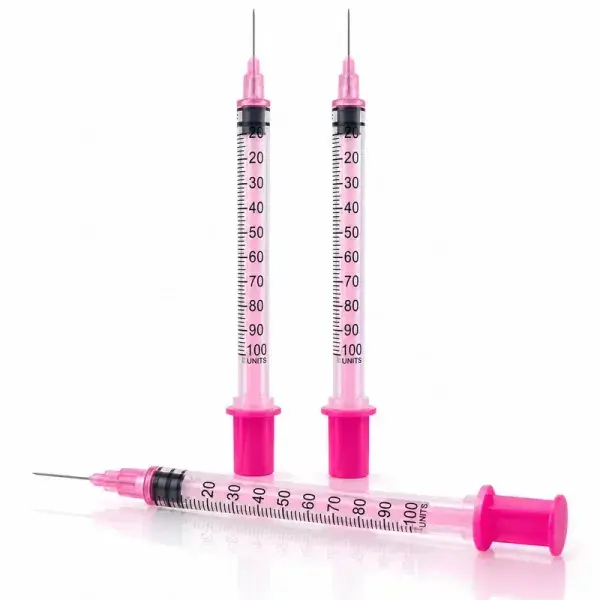
A common two-step approach runs as follows. Put 1 mL of the acid into a 1 mg IGF-1 LR3 vial to give 1 mg per mL and swirl softly until clear. Then dilute the stock with bacteriostatic water if the assay calls for a gentler working solution. For other volumes, let the peptide calculator handle the maths. To measure 1 mL precisely, a U-100 1 mL barrel from our insulin syringes is the easiest option. When you buy 0.6% acetic acid online in Australia, orders paid by 3pm on a business day are dispatched the same afternoon.
Keep unopened vials at room temperature, out of heat and light, until the expiry printed on them. Write the date on the label when you first pierce it and dispose of the vial 28 days afterwards. Reconstituted IGF-1 LR3 should be stored at 2 to 8 °C in aliquots, as outlined in the peptide storage guide.
Household or hardware vinegar will not do, being many times stronger and unsterile. Glacial acetic acid is the undiluted chemical and is much too concentrated to put anywhere near a peptide vial.
For almost every peptide in our range, bacteriostatic water is the standard choice, and its preservative permits multiple draws. Acetic acid 0.6% is the specialist solvent for the few compounds that remain cloudy at neutral pH. It complements preserved water rather than replacing it. Plenty of IGF-1 LR3 protocols use the two together, dissolving in acid and then diluting with water, so a 3 mL acid vial and a 3 mL water vial cover both stages.
Protocols may refer to this solution as 0.1 M acetic acid, 0.1 N acetic acid, 0.6% acetic acid or simply dilute AcOH. The systematic name is ethanoic acid, and chemists abbreviate it to AcOH or HOAc.
Acetic acid is among the most common laboratory chemicals in Australia, and scientific and industrial chemical suppliers sell it in bulk as glacial acid. The Poisons Standard only applies at higher strengths. As of October 2026 the current instrument lists acetic acid in Schedule 5 above 30% and Schedule 6 above 80%. A separate Schedule 2 entry covers preparations above 80% meant for therapeutic use. At 0.6%, this solution is about fifty times weaker than the lowest of those cut-offs, so it is unscheduled.
For a lab the real hurdle is packaging rather than regulation. General chemical suppliers deal in litres of concentrated reagent, not small sterile vials already diluted for reconstitution. Supermarket and hardware acetic acid is unsterile and the wrong concentration, and pharmacies rarely stock a dilute peptide-grade version. NovaPep keeps the 3 mL vial in Australian stock as a lab reagent for dissolving research peptides, sold to adults aged 18 and over and not intended for veterinary or human use.
Only one format is offered, the 3 mL vial, and at roughly 1 mL per IGF-1 LR3 vial it stretches across three reconstitutions within 28 days of first puncture. When your IGF-1 LR3 orders are spaced months apart, buy a new vial each time instead of keeping an opened one. For projects with several IGF-1 LR3 vials, order two or three acid vials from a single lot where stock permits. The 1 mg IGF-1 LR3 vial is what buyers most often pair with this acid diluent, and you will find it in our lab supplies range alongside syringes and water.
NovaPep delivers Australia-wide from local stock, dispatching the same day for orders paid by 3pm on a business day. You can follow every parcel through track order, and the step-by-step reconstitution guide is worth reading before a two-step method.
Acetic acid 0.6% is a sterile dilute acid of roughly 0.1 M at pH 2.9. It dissolves peptides that stay cloudy or clump in neutral water.
Lowering the pH below a peptide's isoelectric point gives every chain the same charge, so the chains repel and stay in solution.
Most labs use it to make IGF-1 LR3 stock solutions for in vitro research. It is a laboratory consumable only.
Bacteriostatic water fits nearly every peptide. The acid is the specialist pick, frequently followed by dilution in water.
Keep the unopened vial away from light and heat. Mark the date at first puncture and dispose of it 28 days later.
One size from Australian stock, labelled with strength, lot and expiry, covering around three IGF-1 LR3 reconstitutions.
It serves as a sterile acidic solvent for reconstituting peptides that clump in neutral water. Its low pH raises the positive charge on the peptide, which keeps the chains separated in solution. NovaPep supplies it for laboratory research only, to buyers aged 18 and over.
Near its isoelectric point a peptide carries no net charge, so the chains clump. At pH 2.9 the chains all carry a positive charge and repel each other. Acetic acid is weak, with a pKa of 4.76, so it lowers the pH enough without the harsh conditions that could break peptide bonds.
Within our range, IGF-1 LR3 is the key peptide that dissolves better in dilute acid. Its data sheets usually specify 0.1 M acetic acid, matching the strength of this 0.6% solution. Nearly every other peptide we stock goes directly into bacteriostatic water at neutral pH with no acid step needed.
Choose bacteriostatic water for almost every peptide, and acetic acid 0.6% only if the compound stays cloudy at neutral pH or its protocol specifies an acid. Many IGF-1 LR3 protocols use them one after the other, so one 3 mL acid vial and one 3 mL water vial handle both stages.
No. It is a sterile consumable rather than a peptide, so it does not go through mass spectrometry or HPLC. Each vial is labelled with lot number, strength and expiry. The IGF-1 LR3 it dissolves has its own lot certificate, available to view in the COA library.
Add the 3 mL vial to your cart on this page, preferably in the same order as the IGF-1 LR3 you plan to dissolve. Stock is held in Australia, and orders paid by 3pm on a business day leave the same day with tracking. Hardware and supermarket acetic acid is unsterile and the wrong strength, so ordering it with your peptide makes the most sense.
NovaPep
 NovaPep
 NovaPep
 NovaPep
10 mg vial