 NovaPep
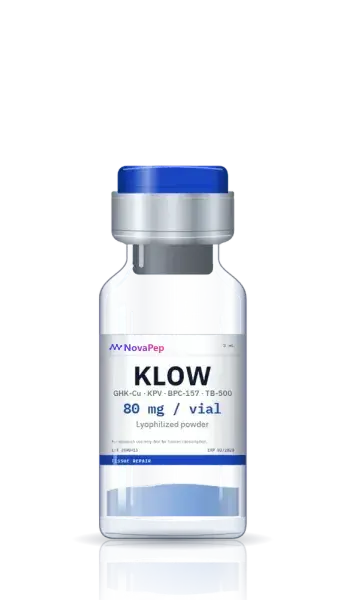
KLOW
80 mg vial
$139
Research use only. NovaPep supplies research-grade peptides for laboratory and in-vitro work only, not for human or veterinary use. By continuing you confirm you are 18 or older and ordering for research.
 NovaPep
In stock in Australia, batch certificate ready
Buy GHK Cu peptide online from NovaPep, the GHK-Cu copper peptide Australian labs order in 50 mg and 100 mg research vials. GHK Cu peptide is glycyl-L-histidyl-L-lysine bound to a copper(II) ion, a tripeptide first detected in human plasma in 1973 that has since become the most researched copper peptide in collagen, matrix and copper transport studies. It acts as a small copper carrier, and the bound copper gives the lyophilised powder its blue colour. Research labs ordering GHK Cu peptide Australia wide can buy it online in two vial sizes, 50 mg and 100 mg, with tested lots shipped from local stock. The identity figures to confirm are C14H22CuN6O4, 401.9 g/mol and CAS 89030-95-5. Mass spectrometry verifies identity and HPLC measures purity on every lot, and the certificate is viewable before checkout. Our GHK-Cu calculator turns any diluent volume into a concentration. If you want to test the copper peptide alongside two repair peptides, add the GLOW blend to the same order. The vials contain powder only, so include bacteriostatic water or choose the starter kit, which already has it. Store the closed vial at -20 °C out of the light. Supplied strictly as a research reagent to adults aged 18 or over.
For laboratory research use only. Not for human or veterinary use. Not TGA approved. See the NovaPep research use policy.
Built from only three amino acids (Gly, His and Lys), GHK-Cu is a very small peptide that carries one copper ion. In research models it behaves as a courier that delivers copper to the cells and enzymes that require it. Unusually for our catalogue, it is also found in nature, circulating at measurable levels in human plasma. Buy GHK-Cu online in Australia as a 50 mg or 100 mg research vial, with the lot certificate published before you order.
In 1973 Loren Pickart isolated the Gly-His-Lys tripeptide from the albumin fraction of human plasma, and his early work on copper binding remains the foundation of the field. The product you receive is the synthetic version, supplied as the preformed complex in which nitrogen atoms of the peptide hold the Cu2+ ion and give both the powder and its solutions a blue tint. Later reports that plasma GHK declines with age shaped much of the research that came after.
The copper is cradled by three nitrogen atoms clustered where glycine meets histidine. The lysine at the opposite end remains free, so its long, positively charged side chain can interact with cell surfaces. This arrangement holds copper(II) tightly, yet published comparisons show its grip is roughly as strong as albumin's best copper binding site, which means the two can pass copper between them. GHK is best thought of as a shuttle rather than a safe. Copper is an essential component of enzymes that build and defend connective tissue, such as lysyl oxidase, which links adjacent collagen strands, and the antioxidant enzyme superoxide dismutase. Delivering copper in a soluble, non-toxic form is the main explanation offered for much of the peptide's activity in culture.
Plasma is not its only origin. Writing in The Journal of Cell Biology in 1994, Lane, Iruela-Arispe, Sage and co-workers reported on SPARC, a matrix protein that cells secrete near injured tissue. When SPARC is broken down, it yields GHK along with the longer KGHK, and both fragments encouraged angiogenesis in the assays used. You will also find the identical three-residue motif within type I collagen, in its alpha 2 chain. One hypothesis, not yet proven, holds that damaged matrix releases GHK right where repair needs to begin, which is why copper peptides for wound healing formed the first line of this research.
So how do copper peptides work in these models? The prevailing view is that GHK supplies copper to enzymes such as lysyl oxidase, which cross-links elastin and collagen. Research on copper peptides for hair centres on follicle explants and cultured dermal papilla cells, and copper peptide hair growth experiments, whether in dishes or in mice, record how large follicles grow and how fast the cells divide. Copper peptides skin studies instead follow fibroblast output, and copper peptide skin explant models add tissue architecture to those measurements. Nearly all published copper peptides collagen data come from cells and animals, and rodent work on copper peptides for wound healing is the longest-running thread of GHK Cu peptide research. Our peptides for skin guide compares these study types, while the limits of what any copper peptide experiment can prove are covered in the GHK-Cu lab results guide.
Labs use this copper peptide GHK-Cu to examine what a small copper carrier does to the glycosaminoglycans, decorin, elastin and collagen that fibroblasts secrete, and whether it tilts matrix metalloproteinase activity relative to the enzymes that inhibit them. Wound studies in rodents take those culture results a step further, and gene expression resources such as the Connectivity Map have associated GHK with wide expression changes that are still only correlative. Copper peptides for skin research and copper peptides hair follicle studies both rely on this body of work, but the vial itself is a research reagent and not a cosmetic or a medicine. Related compounds are grouped in our skin and hair peptides collection. To run this kind of in vitro work, buy GHK-Cu online in Australia from lots tested by HPLC and mass spectrometry.
Many copper peptide skin studies overlook one design issue. Free copper salts have biological effects in their own right, so data from GHK-Cu alone cannot show whether the peptide or the metal was responsible. Our advice is to run three arms as a minimum. Use the full copper complex, then GHK alone without its metal, then a plain copper salt, copper(II) chloride for example, dosed to deliver the same amount of copper. Remember too that any serum in the medium brings albumin, which trades copper with the peptide, so write the serum percentage into each method. For the history of its discovery and the gene expression data, see our full guide to GHK-Cu.
| Product name | GHK-Cu (copper tripeptide-1) |
|---|---|
| Sizes | 50 mg vial, 100 mg vial |
| Structure | Gly-His-Lys bound to copper(II) |
| Residue count | 3 amino acids |
| Formula | C14H22CuN6O4 |
| Molar mass | 401.9 g/mol |
| CAS | 89030-95-5 |
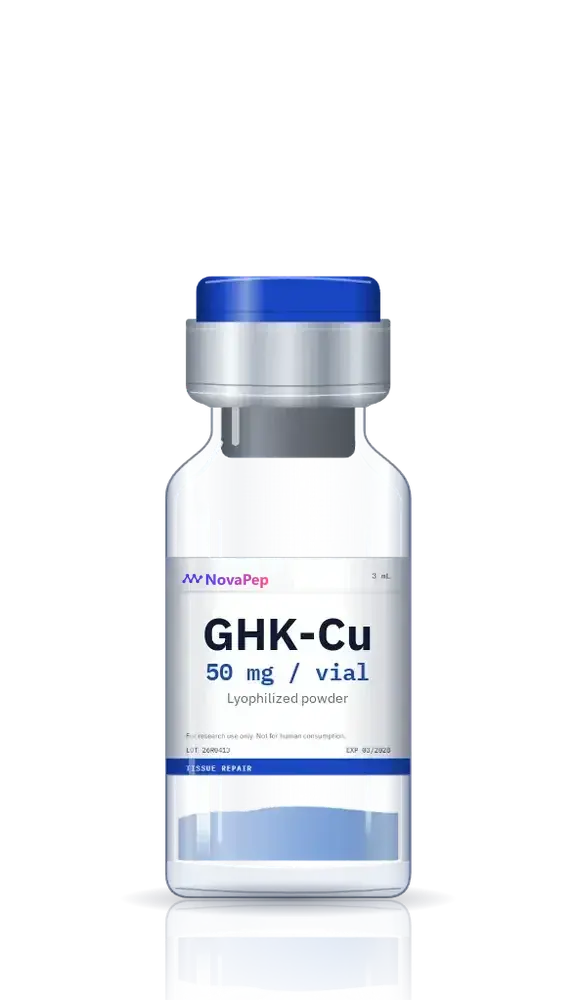
| Physical form | Blue lyophilised powder inside a sealed 3 mL glass vial with a blue cap |
| Quality testing | Identity by mass spectrometry and purity by HPLC, one certificate per lot |
| In the box | A single vial of GHK-Cu, 50 mg or 100 mg, with diluent sold separately or included in the starter kit |
| Storage conditions | Sealed at -20 °C, kept dark and dry, then 2 to 8 °C once dissolved |
| Stock status | In stock in 50 mg and 100 mg fills |
| Intended use | In vitro laboratory research only |
Pick the fill that suits your assay workload, 50 mg for a first purchase or 100 mg for repeat runs. The cake is blue because of the bound copper, and that colour is the first thing worth checking when your parcel lands. Both sizes are held in Australia, and every lot has a published certificate.
Two fast checks tell you that you have the complex rather than the bare peptide. The cake should be distinctly blue, and the certificate's measured mass should correspond to the copper-bound form at around 401.9 g/mol, whereas a white cake implies the copper is absent. HPLC then gives the purity for that particular lot next to its analysis date. Expect that same blue copper peptide tint as the GHK Cu peptide colour in every GHK Cu peptide vial we send, from one lot to the next.
Every report is indexed by lot code in the COA library and can be viewed before ordering. If you are comparing GHK Cu peptides from different suppliers, set those certificates beside this one. When making stock solutions by weight, keep in mind that chromatographic purity and net peptide content are two distinct numbers, an important detail for anyone wanting a pure copper peptide powder with a defined peptide mass.
Allow the vial to reach room temperature, add bacteriostatic water gently along the glass and swirl, as GHK-Cu dissolves fast. For instance, 2 mL in the 50 mg vial makes 25 mg/mL, while 2 mL in the 100 mg vial makes 50 mg/mL. Steer clear of buffers containing EDTA or reducing agents, since they remove or change the copper. Other volumes can be calculated with the GHK-Cu reconstitution calculator. When you buy GHK-Cu online in Australia, orders paid by 3pm on a business day are dispatched the same afternoon.
Knowing how to store GHK Cu peptide is straightforward, as the GHK-Cu peptide powder needs cold, dark and dry conditions. Keep the sealed vial frozen at -20 °C away from light. Hold solutions at 2 to 8 °C in aliquots and use them within 28 days, and throw away any solution that goes green, turns cloudy or loses its blue colour.
Choose GHK-Cu by itself when copper is the variable you need to isolate or when the tripeptide concentration has to be set independently. Choose GLOW when your protocol already specifies GHK-Cu with BPC-157 and TB-500 in a 50 to 10 to 10 ratio within one vial. Once mixed, a blend cannot be rebalanced, so separate vials give you more control.
Our GLOW vs KLOW guide explains how the two blends differ, and both contain the same copper peptide offered on its own here.
Plenty of people encounter this molecule first on a skincare label, listed by its cosmetic ingredient name, copper tripeptide-1, normally at a low percentage within a cream or serum base. A research vial is something else altogether. Ours contains 50 mg or 100 mg of the pure copper complex as a dry blue cake, without emulsifier, preservative, fragrance or carrier, and it is labelled and sold as a laboratory reagent instead of a finished consumer product. Apart from the active molecule, the two have nothing in common. Searches such as copper peptides 1 percent usually point to cosmetic serums that print a strength on the label, a different product class from a reagent vial.
Some labs study a metabolic peptide and a matrix peptide side by side, which is why searches such as reta and GHK peptide or GHK and reta peptides keep appearing. Retatrutide, often shortened to reta, is a triple receptor agonist, while GHK-Cu is a copper carrier, so the two answer very different research questions. Ordering a GHK Cu peptide with retatrutide in one checkout simply saves on postage, and each compound keeps its own lot certificate.
Whether your notes say reta and GHK Cu peptide, reta GHK Cu peptide or reta GHK peptide, these are two separate vials and never a premixed blend. We do not sell a combined product, and the two compounds should not be mixed. Retatrutide fills are listed on our retatrutide product page, and NovaPep gives no advice on combining peptides outside a laboratory.
Many searches for this compound are really about GHK peptide injections, whether phrased as GHK Cu peptide injection Australia, copper peptide injections or a GHK Cu peptide injection protocol. NovaPep cannot help with any of those. Our vials are research reagents for in vitro work, and we give no dosing, injection or administration advice of any kind.
The TGA advisory mentioned above names GHK-Cu among unapproved peptide products, and any GHK peptide injection product is a therapeutic good that sits outside what a research supplier can offer. If your project needs concentration figures, the GHK-Cu calculator converts vial fill and water volume into mg/mL for lab work. For what the literature says about GHK peptides injection safety, read our GHK-Cu side effects guide.
This complex is also listed as GHK-Cu, GHKCu, the GHKCu copper peptide, GHK copper peptide, copper GHK, copper tripeptide-1 (the cosmetic ingredient name), copper peptide GHKCu and glycyl-L-histidyl-L-lysine copper(II). As the most studied copper peptide, GHK-Cu peptide is usually the first one a lab orders. Research papers frequently shorten it to GHK peptide, GHK or GHK-Cu, and supplier catalogues place it with other copper peptides such as AHK-Cu, which has a different sequence. Peptide GHK-Cu and copper peptides GHK Cu also refer to this same vial. Listings may show GHK Cu peptide 50mg or GHK Cu peptide 100mg, and older catalogues file GHKCu copper peptides, GHK copper peptides or Cu GHK peptide under a single entry. What separates peptides from copper peptides is the bound metal ion, because GHK without copper is the bare tripeptide and behaves differently in assays.
Every one of these names leads back to CAS 89030-95-5 and the formula C14H22CuN6O4. Reviews describing GHK-Cu peptide benefits summarise findings from cell culture and animals, not claims made about this product. The same applies to copper peptide benefits, the benefits of GHK peptide and the benefits of copper peptides for skin cells reported in the literature, each one drawn from animals, explanted tissue or cultured cells. In matrix biology papers it tends to appear next to terms such as copper chaperone, TIMP and MMP, decorin, collagen I and III, and fibroblast.
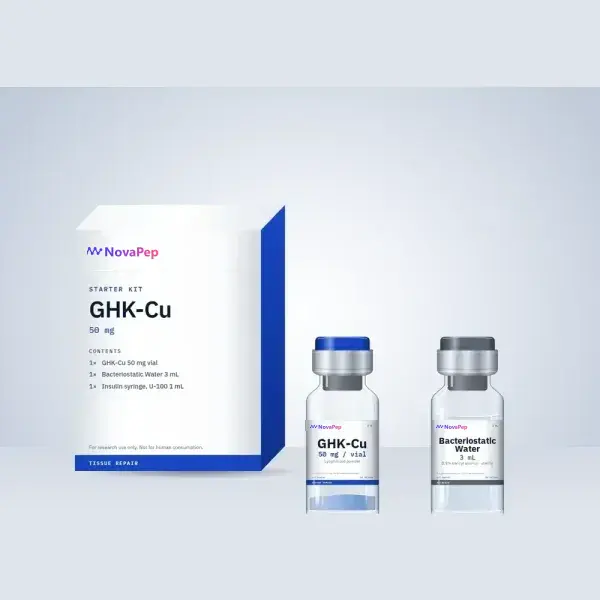
The 50 mg vial fits method development, smaller assay runs and labs trying copper peptides for the first time, and it is the same fill packed in the GHK-Cu Starter Kit along with diluent and a syringe. The 100 mg vial is clearly cheaper per milligram and suits groups running repeated plates across several weeks. In short, the GHK Cu peptide price depends on the fill you pick, and the GHK Cu peptide cost per milligram falls with the bigger vial.
Labs that want to buy copper peptides online rarely need to search for copper peptides near me, because you can order GHK Cu peptide from NovaPep with Australia wide delivery. Many researchers see us as the best place to buy GHK Cu peptide, since every GHK Cu copper peptide lot ships with its certificate.
Order GHK copper peptide for an entire series at once, so the vials share one lot wherever stock permits and a single certificate covers the project. Because synthesising a tripeptide is short, these tripeptides are handled in tens of milligrams rather than single digits, which is why these fills are bigger than most in our range. Only adults aged 18 or over can complete checkout.
That difference determines how each is regulated. In Australia, a cosmetic making only cosmetic claims falls under consumer law and the industrial chemicals scheme administered by AICIS, not the therapeutic goods framework. Pure GHK-Cu offered for injection or another therapeutic purpose comes under the TGA. In April 2026 the TGA listed GHK-Cu, together with BPC-157, TB-500, retatrutide and CJC-1295, in an advisory on unapproved peptide products. These products are not on the ARTG and have not been evaluated for safety, quality or efficacy. As of October 2026 Australia has no registered GHK-Cu medicine, so GHK-Cu Australia supply of the pure compound comes from research suppliers and not pharmacies.
For labs wondering about GHK-Cu peptide where to buy in Australia, the practical answer is a reagent supplier that publishes its own analytical data. NovaPep keeps GHK Cu peptide Australia stock on its own shelves in both fills. Each vial is a research chemical intended for in vitro experiments, buyers must be at least 18, and no vial may be used in people or animals. This same copper complex gives the KLOW four-peptide vial its colour, and our GHK-Cu background guide goes deeper into its discovery and chemistry.
There is no NovaPep shop to visit, because the GHK Cu copper peptides we carry are sold purely through this website, then picked from Australian stock and posted with tracked delivery to any part of the country. Orders placed before 3pm on a business day get same-day dispatch. When labs consider GHK-Cu peptide where to buy in Australia, a supplier with local stock and a published certificate is the answer, and it is also how to get GHK Cu peptide onto the bench without waiting on an import. Order copper peptides from this page and we deliver GHK peptide Australia wide, so the copper peptide Australia labs receive is the same tested complex in whichever fill they choose. For most teams the GHK Cu peptide buy decision comes down simply to fill size. We sell copper peptides Australia wide as pure research powder, and our range of research peptides Australia, GHK-Cu included, ships from the same local stock. If you searched copper peptide near me or GHK Cu peptide near me, this page is the closest source.
Yes. Each lot is analysed twice, once by mass spectrometry to prove the copper complex is present and once by HPLC to put a figure on purity, and the resulting certificate sits in the COA library under your vial's lot code. On delivery, also confirm the powder is blue and record the lot code in your study notes.
It is not. We supply it purely as a research reagent for bench work in vitro, and only buyers who are 18 or older may order it. It has not been formulated, labelled or approved as a cosmetic, therapeutic good or skin treatment, and it is not meant for human or veterinary use.
GHK-Cu is glycine, histidine and lysine holding one copper ion, a small molecule first found in human plasma and now produced synthetically.
Choose the 50 mg vial or the better value 100 mg vial. There is no diluent with the blue powder, so either order bacteriostatic water too or go for the starter kit.
Researched in fibroblast cultures and animal wound models for copper transport, matrix turnover and collagen production, strictly within the lab. GHK Cu peptide for skin research uses dermal fibroblasts and explants.
GLOW combines GHK-Cu with BPC-157 and TB-500 in a single vial, whereas the standalone vial lets you study the copper peptide by itself.
Freeze the sealed vial, then keep the solution refrigerated in aliquots. Discard any solution that fades or turns green.
Every lot is checked by mass spectrometry and HPLC, and its certificate is filed in the COA library under the lot code on the vial.
GHK-Cu is the tripeptide glycyl-L-histidyl-L-lysine holding one copper(II) ion. Loren Pickart isolated GHK from human plasma in 1973, and the same motif also sits inside type I collagen and the matrix protein SPARC. The vial holds the synthetic, preformed copper complex as a blue powder.
The prevailing view is that GHK acts as a copper shuttle. It delivers copper to enzymes such as lysyl oxidase, which cross-links collagen and elastin, and superoxide dismutase. Its grip on copper is close to albumin's, so the two can pass copper between them in serum-containing media.
The blue comes from the copper(II) ion held by the glycine and histidine nitrogens of the tripeptide. A deep blue cake in a GHK-Cu vial is normal and shows the complex has formed. A white or very pale cake suggests the copper is missing, and any green or cloudy solution should be thrown away.
For pilot runs and method work, the 50 mg vial is the logical first purchase. The 100 mg vial offers better value per milligram for teams doing repeated assays, as long as the solution is used within 28 days of mixing. Buying a few vials in the same checkout keeps them on a single lot whenever stock makes that possible.
Shoppers often check pharmacy chains such as Chemist Warehouse first. Products found there are cosmetics or supplements, which differ from research-grade lyophilised peptides. A search for GHK Cu peptide Chemist Warehouse is therefore a search for skincare, not a sealed reagent vial with a lot certificate. NovaPep sells the pure research compound online only.
Online from NovaPep, as a 50 mg copper peptide vial or a 100 mg vial, posted from Australian stock. Every lot has an identity and purity certificate in the COA library, and the vials are sold for in vitro research to adults 18 or over. Personal questions, such as using copper peptides during pregnancy, are medical ones for a doctor, and our GHK-Cu side effects guide covers what research has and has not shown.
NovaPep
80 mg vial
 NovaPep
Kit
 NovaPep
Bundle
 NovaPep
70 mg vial