 NovaPep
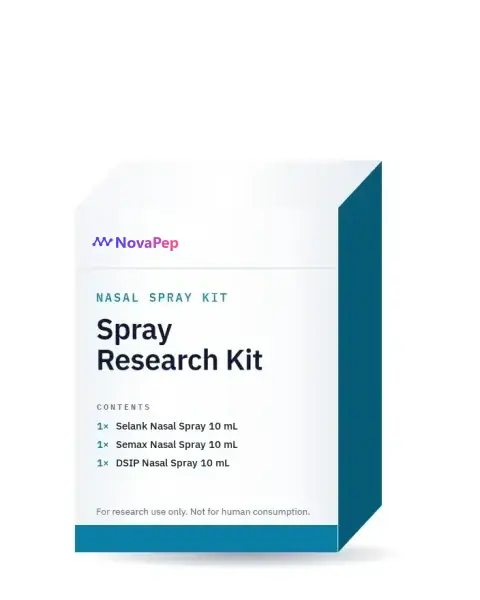
Spray Research Kit
Kit
$179
Research use only. NovaPep supplies research-grade peptides for laboratory and in-vitro work only, not for human or veterinary use. By continuing you confirm you are 18 or older and ordering for research.
 NovaPep
In stock in Australia, batch certificate ready
Size: Kit
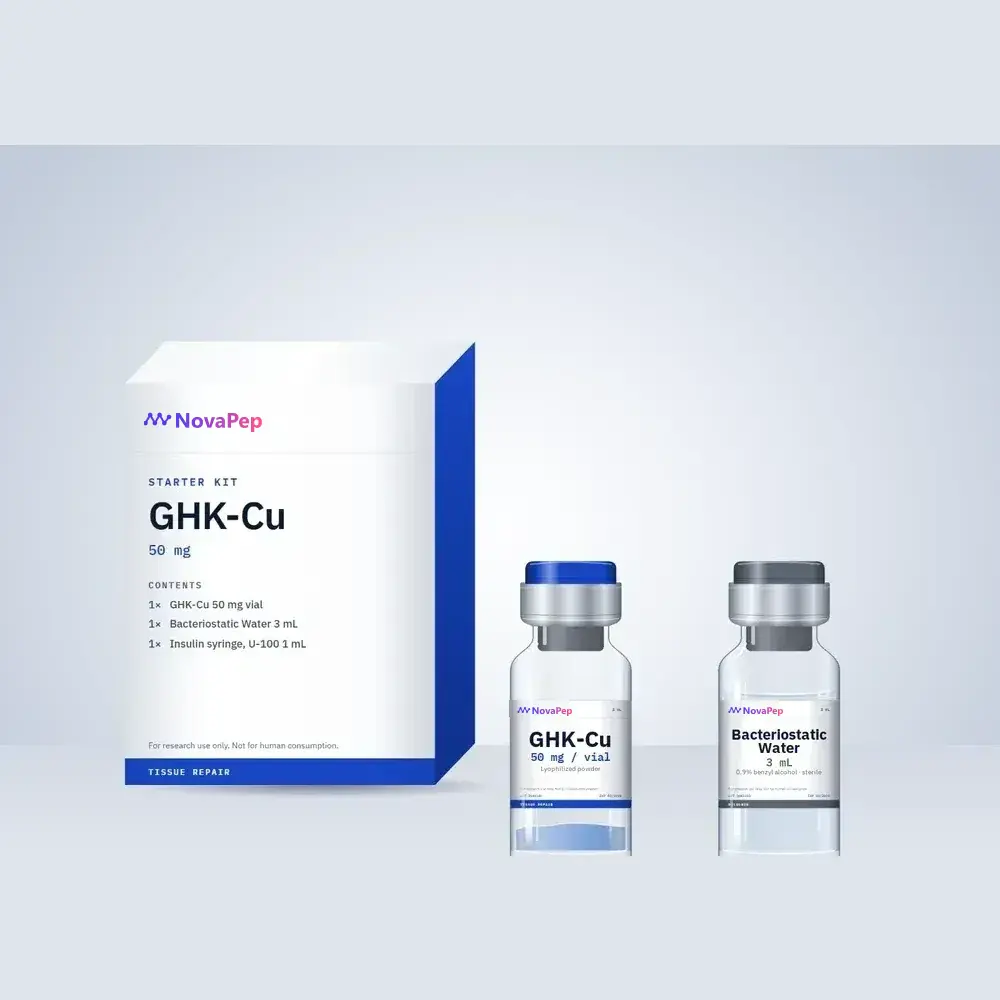
Buy the GHK-Cu Starter Kit online in Australia, with a 50 mg research vial, 3 mL of bacteriostatic water and a U-100 syringe in one carton. The GHK-Cu Starter Kit, our GHK Cu peptide kit, is one carton containing a 50 mg GHK-Cu vial, 3 mL of bacteriostatic water and one U-100 insulin syringe. Chemically, GHK-Cu is glycyl-L-histidyl-L-lysine carrying a copper(II) ion, a tripeptide that researchers first pulled from human plasma in 1973. It binds copper through nitrogens on its histidine and glycine, which is what gives the powder its blue colour. The kit is available online in Australia from local stock. The identity figures to confirm are C14H22CuN6O4, 401.9 g/mol and CAS 89030-95-5. Mass spectrometry verifies every GHK-Cu lot and HPLC measures its purity, and the certificate can be viewed before checkout. Convert the supplied water volume into a concentration with the GHK-Cu calculator. If your study also calls for KPV and BPC-157, the Radiance Bundle is the better pick. Because the diluent is already in the box, simply keep the sealed peptide vial frozen at -20 °C and away from light until you are ready to start. Sold as a research reagent to adults aged 18 or over and listed in our skin and hair peptides collection.
For laboratory research use only. Not for human or veterinary use. Not TGA approved. See the NovaPep research use policy.
One carton brings together the copper peptide, the preserved water that dissolves it and a graduated syringe to measure that water, so a single purchase takes you from dry powder to a working solution. Every item has a defined role, and each has a near relative that would cause problems if substituted. The GHK-Cu Starter Kit is for sale in Australia as one carton with a 50 mg vial, diluent and a syringe, ready to order online from local stock.
Open the carton and you will find three individually sealed items. The first is the 50 mg peptide vial, its blue cake sitting beneath a flip-off cap and its label carrying the lot code that ties it to a certificate. Next comes 3 mL of bacteriostatic water in a glass vial, where 0.9% benzyl alcohol preserves the sterile water so its stopper tolerates repeated piercing. Last is one sterile U-100 insulin syringe, 1 mL in capacity and meant for a single use. None of it is premixed, so the peptide remains dry and stable until bench work begins.
Inside the 50 mg vial is GHK-Cu, a three-residue peptide holding one copper ion, freeze-dried so the complex remains stable until water goes in. Freeze-drying strips out moisture under vacuum at a low temperature, leaving a light, porous cake that dissolves within seconds. The single GHK-Cu product page covers the compound in detail, including where it was found in plasma and its matrix research, so that background is not repeated here.
This is sterile water with 0.9% benzyl alcohol added. Benzyl alcohol is bacteriostatic, so it suppresses bacterial growth without sterilising, and that lets the stopper be pierced repeatedly over the weeks that follow. Two similar products are worth knowing about. Sterile water for injection carries no preservative and is meant for a single draw, while sodium chloride 0.9% (saline) brings salt that some peptides handle badly. For a copper complex, plain preserved water is the cleanest option, because it introduces no chelating additives and no phosphate buffer, which can cause copper to precipitate.
U-100 means the barrel is marked so that 100 units equal 1 mL, which makes one unit 0.01 mL. Because the needle is fixed to the barrel, dead space is minimal and less liquid is wasted than with a syringe whose needle detaches.
New buyers trip over that final point more than any other. A unit mark tells you nothing about milligrams until the concentration is set, so record the water volume you added on the vial label before drawing anything. If your lab already stocks diluent and syringes, the carton is unnecessary, and our comparison of preserved and plain sterile water explores the choice of diluent further.
Three nitrogen atoms grip the copper, one from the histidine imidazole ring, one from the free amino group of glycine and one from the deprotonated amide bond joining those residues, which leaves lysine free to engage cell surface receptors. Because the complex absorbs red light, authentic GHK-Cu appears blue both as powder and once dissolved. A white or grey cake sold under the same name is a sign the copper is absent.
GHK itself is a small carrier for copper. Bound copper is what makes the complex distinct from the free tripeptide, and the lysine left free in the structure is where interaction with cells is thought to happen.
In 1973 Loren Pickart isolated GHK from human plasma and demonstrated its strong affinity for copper(II). Since then the copper complex has become one of the most researched small peptides in connective tissue science. Labs typically use it to explore matrix biology, specifically how a tripeptide carrying copper changes the production of collagen, elastin and glycosaminoglycans by cultured fibroblasts. Shop the GHK-Cu Starter Kit online in Australia for this research, knowing each lot has been checked for identity and purity.
Research groups also use it in rodent wound models and in gene expression studies of tissue remodelling. The vial in this carton is a research reagent, neither a cosmetic ingredient nor a medicine, and it arrives with the diluent and syringe you need to dissolve it the day it is delivered.
| Product name | GHK-Cu Starter Kit |
|---|---|
| Format | One carton |
| Structure | Gly-His-Lys bound to copper(II) |
| Residue count | 3 amino acids |
| Formula | C14H22CuN6O4 |
| Molar mass | 401.9 g/mol |
| CAS | 89030-95-5 |
| Physical form | Blue lyophilised powder inside a sealed glass vial |
| Quality testing | Every GHK-Cu lot verified by mass spectrometry and HPLC, with its own certificate |
| In the box | A 50 mg GHK-Cu vial, a 3 mL bacteriostatic water vial (0.9% benzyl alcohol) and a sterile U-100 1 mL insulin syringe |
| Storage conditions | Sealed peptide vial at -20 °C for long holds or 2 to 8 °C for use soon, kept from light. Water and syringe at room temperature |
| Stock status | In stock |
| Intended use | In vitro laboratory research only |
This carton is a sensible first copper peptide order. None of the contents are trial sizes, the three items would cost more bought separately, and the blue vial contains exactly the material we sell on the standalone GHK-Cu page.
Colour offers a fast first check, yet only analysis proves the compound. On the certificate, confirm a measured mass in line with 401.9 g/mol and the HPLC purity stated for the lot. Look your lot up in the COA library, where each report is indexed by the number printed on the vial. A blue cake on opening plus a matching certificate gives you two independent signs that the compound is right.
For preparation, let the vial reach room temperature, wipe both stoppers, draw 2 mL of water with the supplied syringe as two full 1 mL draws, and run it down the glass before swirling softly. The result is 25 mg per mL, and other volumes can be calculated with the GHK-Cu reconstitution calculator. A step-by-step method is set out in how to reconstitute peptides. The GHK-Cu Starter Kit for sale in Australia leaves our shelves by tracked post, so it reaches your bench in good condition.
When the work is still weeks off, put the sealed vial at -20 °C as soon as it arrives, and for use in the near term 2 to 8 °C is fine. Keep it shielded from light. Store reconstituted GHK-Cu in the fridge, preferably in aliquots, and throw out the water vial 28 days after it was first pierced.
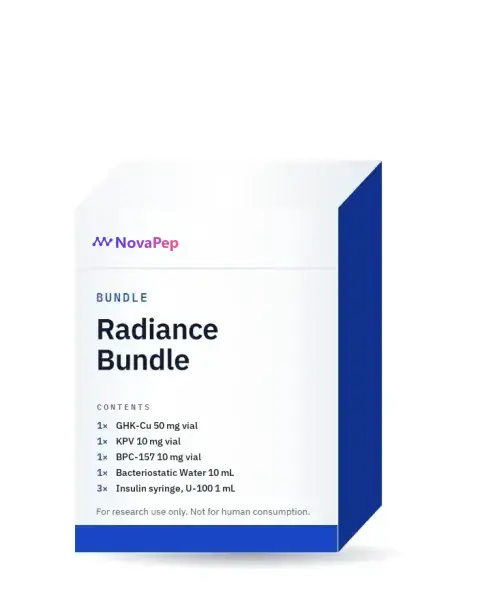
Choose this carton when GHK-Cu is the sole compound in your study. For a study that sets GHK-Cu beside a tissue repair pentadecapeptide and an anti-inflammatory tripeptide, the Radiance Bundle includes KPV 10 mg and BPC-157 10 mg as separate vials, plus 10 mL of water and three syringes.
If a fixed ratio in a single vial suits your lab better, consider the GLOW blend, which pairs GHK-Cu with BPC-157 and TB-500. Our GLOW vs KLOW comparison sets out how the premixed blends differ from buying separate vials.
In ingredient lists GHK-Cu may appear as copper tripeptide-1, in papers as Cu-GHK or GHK copper, and chemically as glycyl-L-histidyl-L-lysine copper(II). Prezatide copper is the non-proprietary drug name you may also see. Every one of these refers to a single complex registered as CAS 89030-95-5.
The carton may also be described as a GHK-Cu kit or a copper peptide starter kit. Regardless of the label, what you get does not change, one U-100 syringe, a 3 mL vial of preserved water and the 50 mg blue peptide vial.
There is a single configuration, with volumes matched to the vial. The kit costs less than the three parts bought separately, with supplies included. Using 2 mL of the supplied water produces 25 mg per mL, and the full 3 mL produces roughly 16.7 mg per mL, with both volumes fitting within the one water vial.
For a longer series, order several cartons together and we will pack them from a single GHK-Cu lot under one certificate wherever stock permits. Once you have water and syringes on hand, the standalone 100 mg vial is the cheaper reorder per milligram. Every buyer confirms at checkout that they are 18 or older.
Each of the three falls into a different regulatory category. As of October 2026 there is no registered GHK-Cu medicine on the ARTG, and the TGA mentioned it in an April 2026 advisory about unapproved peptide products. That is why a GHK-Cu kit in Australia is sourced from a reagent supplier rather than a pharmacy. Bacteriostatic water is also scarce at retail chemists, who usually stock single-use Water for Injections ampoules instead, a product without preservative. Insulin syringes, on the other hand, are a routine pharmacy item and are provided free to registered insulin users under the NDSS, though that scheme does not cover laboratory buyers. Our insulin syringe buying guide walks through those supply routes.
Packing the three together answers a practical need rather than a legal one, since the diluent volume and syringe scale are sized for the 50 mg fill. NovaPep sends the GHK-Cu kit in Australia out of its local warehouse, supplied as in vitro research equipment to buyers who are at least 18, and it is never for human or veterinary use. If you later want only the peptide, the 100 mg GHK-Cu vial can be reordered by itself.
Copper peptide creams are sold in plenty of shops, but a lyophilised research vial with matched diluent is much harder to find. NovaPep trades online only, without a shopfront, and ships throughout Australia from local stock, so a lab ordering peptides in Adelaide receives the same lots as one in Darwin. Cartons paid for before 3pm on a business day are packed and dispatched that afternoon, and transit times by state are listed on the delivery information page.
GHK-Cu is glycyl-histidyl-lysine complexed with copper(II), which turns it blue. The carton holds everything you need for a first reconstitution.
A 50 mg vial, 3 mL of bacteriostatic water and a U-100 syringe, costing less than the three items bought separately.
Used by labs in fibroblast cultures for collagen and elastin studies and in rodent wound models. For research use only.
This carton covers GHK-Cu by itself. The Radiance Bundle adds separate KPV and BPC-157 vials for a three-compound study.
Freeze the sealed vial at -20 °C for longer storage or refrigerate it if using soon. Keep reconstituted solution at 2 to 8 °C.
Confirm the blue colour when it arrives, then match the lot number to its mass spectrometry and HPLC report.
It is one carton holding a 50 mg vial of GHK-Cu, the copper(II) complex of the tripeptide glycyl-L-histidyl-L-lysine, plus 3 mL of bacteriostatic water and a U-100 insulin syringe. The water volume and syringe scale are sized for the 50 mg fill, so the powder can be reconstituted the day it arrives.
Put the carton in your cart on this page and complete checkout. It leaves from Australian stock, and any order paid before 3pm on a business day is packed and sent that afternoon. Inside you get the 50 mg vial, 3 mL of bacteriostatic water and a U-100 syringe, so you have everything needed to start.
Yes, the GHK-Cu vial is drawn from a lot that has its own certificate. Identity is confirmed by mass spectrometry and purity by HPLC, and the report is kept in the COA library under the lot number on the vial. The water and syringe are sterile supplies labelled with their lot and expiry.
Go with the kit when GHK-Cu is the only peptide your study uses. Pick the Radiance Bundle if you also need KPV and BPC-157, as it supplies all three in separate vials along with 10 mL of water and three syringes, costing less than the individual parts.
The copper(II) ion attached to the tripeptide absorbs red light, which produces the blue colour. Real GHK-Cu is blue in powder form and in solution. A white or grey cake sold under that name points to missing copper, which is one more reason to check the certificate too.
The carton provides everything needed to reconstitute GHK-Cu for in vitro and animal model studies of collagen, elastin and tissue remodelling. It is sold only to adults aged 18 or over as laboratory material. It is neither a cosmetic nor a medicine and is not for human or veterinary use.
NovaPep
Kit
 NovaPep
Bundle
 NovaPep
 NovaPep
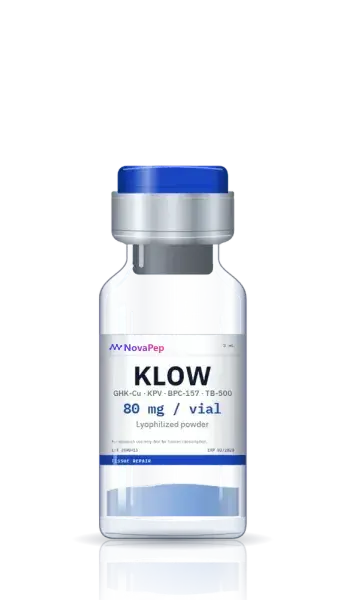
80 mg vial