 NovaPep
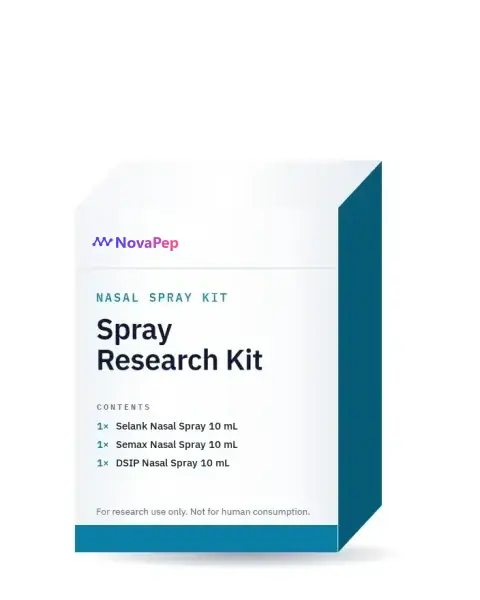
Spray Research Kit
Kit
$179
Research use only. NovaPep supplies research-grade peptides for laboratory and in-vitro work only, not for human or veterinary use. By continuing you confirm you are 18 or older and ordering for research.
 NovaPep
In stock in Australia, batch certificate ready
Size: Bundle
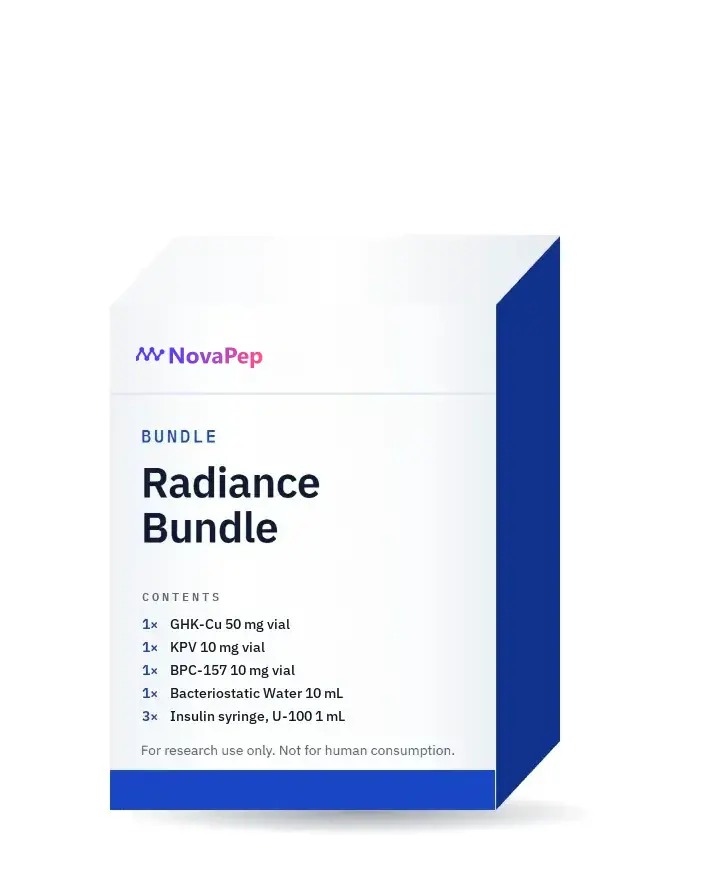
Buy the Radiance Bundle online in Australia, with GHK-Cu, KPV and BPC-157 research vials, bacteriostatic water and three syringes in one carton. The Radiance peptide bundle, packed in Australia, is a boxed trio of single research peptides, BPC-157 10 mg, KPV 10 mg and GHK-Cu 50 mg, each sealed in its own vial. GHK-Cu is Gly-His-Lys bound to copper(II) (C14H22CuN6O4, CAS 89030-95-5) and is researched for collagen and matrix remodelling in fibroblasts. KPV, the tripeptide Lys-Pro-Val (C16H30N4O4, CAS 67727-97-3), comes from the C-terminal end of alpha-MSH and is studied in inflammation models. BPC-157 (C62H98N16O22, CAS 137525-51-0) is a chain of 15 residues derived from a gastric protein, with a long rodent history in tissue repair research. The carton also holds 10 mL of bacteriostatic water plus a set of three 1 mL U-100 syringes. Every peptide lot is checked by HPLC for purity and confirmed by mass spectrometry, so there are three certificates you can review before paying. Use the GHK-Cu calculator and the BPC-157 calculator to turn water volumes into concentrations. If the copper peptide is all you need, the smaller GHK-Cu Starter Kit is the better order. Sealed vials should be stored in the dark at -20 °C. Supplied as research reagents to adults 18 and over.
For laboratory research use only. Not for human or veterinary use. Not TGA approved. See the NovaPep research use policy.
The Radiance peptide bundle is a boxed trio of single research peptides, each sealed in a vial of its own and packed with the preserved water and syringes required to dissolve and measure them. Treat it as a ready-to-go toolkit for skin and tissue models and not as a formula, because nothing is premixed and any compound can be used by itself. Buy the Radiance Bundle online in Australia as one carton of three research vials with water and syringes, with the lot certificate published before you order.
Radiance is simply the name we gave a carton. You will not find it in any publication as a compound, a brand or a formula. Inside you will count seven items. There are three stoppered peptide vials (a blue 50 mg GHK-Cu cake plus white cakes holding 10 mg of KPV and 10 mg of BPC-157), along with three sterile U-100 syringes and one 10 mL vial of bacteriostatic water. Every peptide vial has its own lot code, so the box ties to three distinct certificates instead of one combined report, and no powder is blended with any other.
Each compound addresses a different layer of what unfolds when skin or soft tissue is injured in a model. BPC-157 covers blood supply, with a long rodent history connected to nitric oxide and the growth of new vessels. KPV covers inflammation, being the three-residue tail of alpha-MSH that reduced NF-kappa B signalling within epithelial cells in published culture studies. GHK-Cu covers the matrix, as a copper carrier researched for collagen production and remodelling in fibroblasts. Placed next to each other, they allow a single study to ask which layer is behind a particular result. More detail on the two less familiar compounds is on the pages for KPV, the tripeptide from alpha-MSH and BPC-157 in vial and capsule formats.
A premixed blend can be tested only as one unit. Three independent vials make a full factorial design possible, which is the strongest reason to pick this carton of skin research peptides over any blended product.
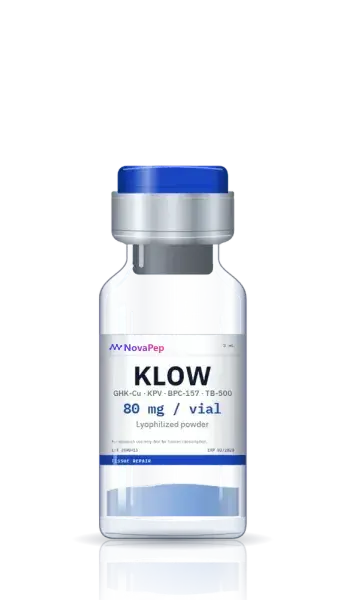
A design like this depends on setting concentrations carefully, and molar mass is where it goes wrong. KPV weighs roughly a quarter as much as BPC-157, so one milligram of KPV carries about four times as many molecules as one milligram of BPC-157, and GHK-Cu is close to KPV. Matching all three by weight therefore weights the two tripeptides much more heavily than the pentadecapeptide. We suggest you settle whether your hypothesis concerns equal mass or equal molecule numbers before mixing anything, record that decision in the protocol, and work out the stock concentrations once on paper instead of at the bench. This is also the key difference between the Radiance carton and KLOW, which replaces separate vials with a single fixed cake of four peptides and includes TB-500.
All three compounds sit in one research field yet work in different ways. BPC-157 has a rodent body of work on gut, tendon and soft tissue repair stretching back to the early 1990s. KPV is investigated in cell and rodent inflammation models, experimental colitis among them. GHK-Cu turns up in rodent wound studies and fibroblast cultures looking at elastin and collagen. To run this kind of in vitro work, buy the Radiance Bundle online in Australia from lots tested by HPLC and mass spectrometry.
Boxing them together answers a frequent lab question, namely how a gastric pentadecapeptide, a melanocortin fragment and a copper peptide stack up, separately and in combination, within the same tissue model. Every vial is a research reagent, and the bundle name suggests no cosmetic or therapeutic result. You will find the carton in our skin and hair peptides range.
| Product name | Radiance Bundle |
|---|---|
| Pack | One carton |
| Sequences | BPC-157 reads Gly-Glu-Pro-Pro-Pro-Gly-Lys-Pro-Ala-Asp-Asp-Ala-Gly-Leu-Val. KPV reads Lys-Pro-Val. GHK-Cu reads Gly-His-Lys bound to copper(II) |
| Formulas | BPC-157 C62H98N16O22, KPV C16H30N4O4, GHK-Cu C14H22CuN6O4 |
| Molecular weights | BPC-157 1419.5 g/mol, KPV 342.4 g/mol, GHK-Cu 401.9 g/mol |
| CAS | BPC-157 137525-51-0, KPV 67727-97-3, GHK-Cu 89030-95-5 |
| Appearance | Lyophilised powder across three sealed glass vials |
| Quality checks | HPLC measures and mass spectrometry confirms every peptide lot, with one certificate per lot |
| In the box | Three sterile U-100 1 mL insulin syringes, a 10 mL vial of bacteriostatic water (0.9% benzyl alcohol), plus peptide vials of BPC-157 10 mg, KPV 10 mg and GHK-Cu 50 mg |
| Storage conditions | Keep unopened vials dark, at -20 °C for extended storage or 2 to 8 °C when they will be used shortly. Syringes and water can stay at room temperature |
| Stock status | In stock |
| Intended use | In vitro laboratory research only |
The carton suits a study that needs all three compounds with each one kept separate. Individual vials allow a design to measure, combine or omit any single peptide, something a fixed blend never permits.
On paper the three molecules are simple to distinguish. GHK-Cu is a blue copper complex of 401.9 g/mol, KPV is an unmodified tripeptide of 342.4 g/mol, and BPC-157 is a 15-residue chain weighing 1419.5 g/mol whose N-terminal stretch is rich in proline. The blue cake marks the GHK-Cu vial instantly, while the remaining two are white.
Since each lot is tested separately, you have three reports to review, one for every vial, each tied to the lot code printed on that vial. Pull them up in the COA library and check the measured masses and HPLC purity before any vial enters a study. Our explainer on how to read a COA shows what to look for.
Using 2 mL per vial gives GHK-Cu at 25 mg per mL and both KPV and BPC-157 at 5 mg per mL, which uses 6 mL from the 10 mL water vial with 4 mL left over. Other volumes can be worked out with the BPC-157 reconstitution calculator, and using a new syringe for each vial prevents any carry-over between solutions. Write the date and concentration on every vial right after mixing, since a pair of the three solutions look clear and are impossible to tell apart on a fridge shelf. When you buy the Radiance Bundle online in Australia, orders paid by 3pm on a business day are dispatched the same afternoon.
The 28-day clock begins the first time the water stopper is pierced, so either make up all three vials around the same time or keep the sealed peptide vials in a -20 °C freezer until they are needed. After reconstitution, store each vial at 2 to 8 °C, preferably split into aliquots.
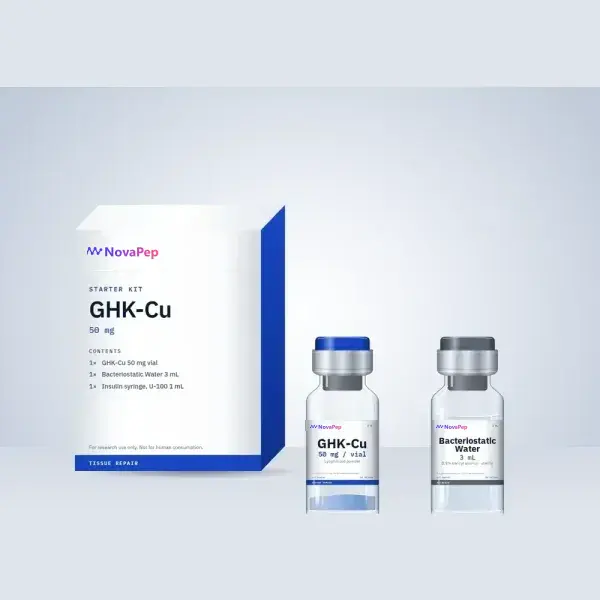
Where GHK-Cu is the sole compound in your design, the GHK-Cu Starter Kit is the carton to choose. The bundle is worth it when a comparison calls for all three, because it costs less than putting the same contents together yourself.
Labs preferring the compounds in one vial at a set ratio can consider the KLOW blend instead. Our GLOW vs KLOW guide sets out the trade-off between premixed blends and separate vials.
Prezatide copper and copper tripeptide-1 are alternative names for GHK-Cu. KPV goes by alpha-MSH (11-13), because it matches the last three residues of alpha-melanocyte-stimulating hormone. BPC-157 is short for body protection compound 157, and earlier papers list it as PL 14736 or bepecin.
The carton is sometimes described as a skin research peptide bundle, or as a BPC-157, KPV and GHK-Cu kit. Whatever it is called, every box holds three syringes, three vials and 10 mL of preserved water.
Regulators judge the contents of each vial, and each answer is different. BPC-157 is the most strictly controlled of the three, and has been in Schedule 4 (prescription only) of the Poisons Standard since 1 June 2024, as well as appearing on the S0 list kept by WADA. GHK-Cu is well known in cosmetics as copper tripeptide-1, yet no approval exists for the pure compound in therapeutic use. It was singled out by name when the TGA warned in April 2026 about peptide products missing from the ARTG. KPV has the lowest profile, as our search turned up no Poisons Standard entry naming it, and no therapeutic use has been approved. No registered medicine in Australia contained any of the three as of October 2026, while the syringes and water serve only as supplies for making up solutions.
Given that mix, only laboratory suppliers stock a skin research peptide bundle of this kind. NovaPep packs the Radiance Bundle locally from Australian stock for in vitro research, sells it only to adults 18 and over, and excludes all human or veterinary use. If your project needs only the anti-inflammatory tripeptide, the standalone KPV vial is cheaper, and our guide to BPC-157's legal status covers the most tightly regulated component in detail.
There is a single configuration. The bundle costs less than buying the 10 mg BPC-157 vial, the 10 mg KPV vial, the 50 mg GHK-Cu vial, the 10 mL water and three syringes one by one. When a study needs GHK-Cu alone, that saving vanishes and the smaller starter kit makes more sense.
For a longer project, order several bundles at once so that, where stock permits, each compound comes from one lot with one certificate per peptide. You then hold three tidy analytical records rather than a jumble of lots, and data from week one can be compared with week six without worrying that another batch slipped in. We accept orders solely from adults of at least 18.
You will not find a retail shop that packs these three research peptides into one box. NovaPep assembles the carton from Australian stock and sells it only online, and bundles paid for before 3pm on a business day leave that same afternoon, with timing detailed on the delivery information page.
Each of the three peptides comes in its own vial, so you can measure each compound alone or combine them.
The box contains three U-100 syringes, 10 mL of bacteriostatic water and three peptide vials, for less than the separate items.
Researchers study them in rodent repair work, inflammation models and fibroblast cultures, solely in the laboratory.
For designs using only the copper peptide, the GHK-Cu starter kit holds that single compound and its supplies.
Hold unopened vials at -20 °C until needed. Store reconstituted solutions at 2 to 8 °C and use one syringe per vial.
Each peptide lot is checked by HPLC and confirmed by mass spectrometry, and every certificate can be opened in the COA library.
The carton holds BPC-157, KPV and GHK-Cu in separate vials. In published research, BPC-157 is linked to blood supply and nitric oxide in rodent models, KPV to reduced NF-kappa B signalling in epithelial cells, and GHK-Cu to collagen production and remodelling in fibroblasts.
Yes, by ordering online from NovaPep. Put the bundle in your cart, and bundles paid for before 3pm on a business day leave local stock the same afternoon for any Australian state or territory. No retail outlet boxes these three research peptides together, and NovaPep has no shopfront, so every lab receives identical tested lots.
Yes, every one of the three peptides has a separate lot certificate. HPLC measures purity and mass spectrometry confirms identity for GHK-Cu, KPV and BPC-157 individually. Find each report in the COA library with the lot number printed on the corresponding vial label.
Buy the Radiance Bundle if your study requires GHK-Cu, KPV and BPC-157 together, as the carton costs less than its parts. Pick the GHK-Cu Starter Kit if GHK-Cu alone is required, because the bundle discount then no longer helps.
Individual vials allow a study to test each compound alone, mix them in any ratio or drop one entirely. A premixed blend locks the ratio inside one vial, which works for certain designs but takes away that flexibility. Labs wanting a fixed mix can look at the KLOW and GLOW blends instead.
Researchers use this boxed set of three peptides, diluent and syringes to compare what a gastric pentadecapeptide, a melanocortin fragment and a copper peptide each do in animal and cell tissue models. NovaPep sells it as research material only to buyers 18 or older, and it is not for human or veterinary use.
NovaPep
Kit
 NovaPep
Kit
 NovaPep
 NovaPep
80 mg vial