 NovaPep
BPC-157
From $69
Research use only. NovaPep supplies research-grade peptides for laboratory and in-vitro work only, not for human or veterinary use. By continuing you confirm you are 18 or older and ordering for research.
 NovaPep
In stock in Australia, batch certificate ready
Size: 10 mg vial
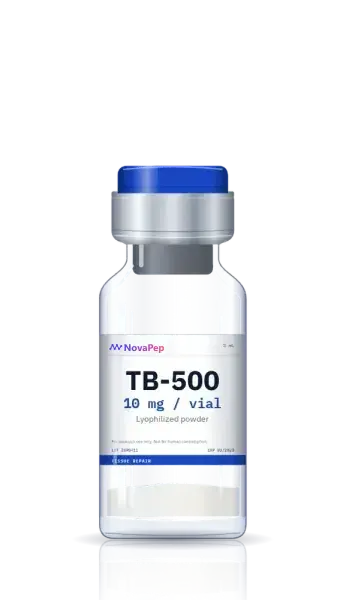
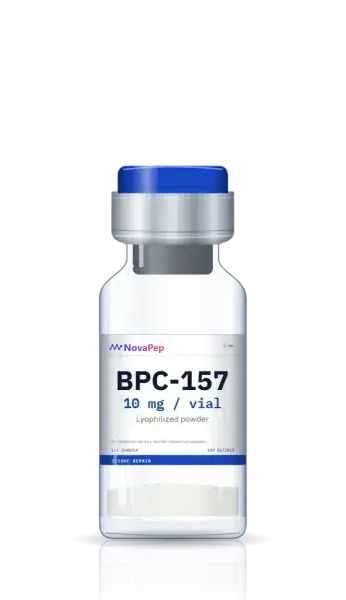
Buy Wolverine stack peptides online in Australia as one 10 mg research vial, the Wolverine peptides blend of 5 mg BPC-157 and 5 mg TB-500. BPC 157 TB 500 in the Wolverine Blend means 5 mg of BPC-157 and 5 mg of TB-500 freeze-dried together as one cake, a set one to one ratio by weight. This is the plainest form of Wolverine stack peptides, two separate molecules sharing a container rather than a brand new compound, studied in tissue repair models for different stages of the same process. BPC-157 is the 15-residue gastric pentadecapeptide (CAS 137525-51-0, 1419.5 g/mol), while TB-500 is the acetylated 17 to 23 fragment of thymosin beta-4 (CAS 885340-08-9, 889.0 g/mol). It comes as a single 10 mg lyophilised vial from Australian stock. A single lot number applies to both, mass spectrometry verifies that each peptide is present, HPLC measures purity, and you can open the certificate ahead of checkout. Use the Wolverine blend calculator to break the concentration down into each component's share. If your project also examines KPV or copper peptide signalling, the four-part KLOW blend can join the same order. Powder only ships in the vial, so include bacteriostatic water. Keep the sealed blend at -20 °C. A research reagent available only to adults aged 18 and over.
For laboratory research use only. Not for human or veterinary use. Not TGA approved. See the NovaPep research use policy.
The Wolverine peptide blend is one vial in which equal weights of BPC-157 and TB-500 are lyophilised into a single cake, so a single reconstitution produces a solution holding both. It is a format chosen for convenience and not a new molecule. No bond forms between the chains, and each behaves in solution precisely as it would from its own vial. The nickname is lifted from comic-book fiction and tells you nothing about the chemistry. The Wolverine blend is for sale in Australia as a 10 mg research vial, ready to order online from local stock.
Wolverine is simply shorthand for the BPC-157 and TB-500 pairing, two peptides that emerged from unconnected research lines. BPC-157 came out of the Zagreb group's work on a gastric juice protein in the early 1990s. TB-500 derives from thymosin beta-4, which was isolated from calf thymus and later narrowed to an actin-binding motif. They come together in preclinical tissue repair literature because they appear to influence different stages of one process.
Telling the chains apart is simple, as one is proline-rich and uncapped while the other is short, acetylated and lysine-rich. Both have their own pages, the gastric pentadecapeptide BPC-157 and the thymosin fragment TB-500, covering origin and structure.
Repair in a wounded tissue model proceeds through phases that overlap. Cells must first arrive at the damaged site, a blood supply then has to form, and new matrix is subsequently laid down and organised. Each component is thought to act at a different point in that order.
TB-500, the actin-binding motif from thymosin beta-4, is studied around the migration step, where cells reorganise their internal scaffolding in order to travel. BPC-157 is studied later in the sequence, in fibroblast and vascular research focused on new capillaries and nitric oxide. Combining them allows a lab to ask whether targeting two phases simultaneously shifts an outcome that neither shifts by itself.
Put as a research question, what occurs in a given model when nitric oxide and growth factor signalling operate at the same time as actin-driven cell migration? That is the question the blend is built to ask.
Nearly all published findings relate to each peptide tested on its own, in rodent models and cell culture. We know of no peer-reviewed controlled study that compared this exact pairing against both single compounds. The case for the Wolverine peptide stack therefore rests on mechanism and not on a combined result. Shop the Wolverine blend online in Australia for this research, knowing each lot has been checked for identity and purity.
A well designed study could close that gap, and it is precisely why single-compound arms belong in any protocol built around the blend. Controls using one compound are also the only route to attributing an observation to a particular peptide. Many groups hold a few individual vials next to the blend for that reason, as explained in our BPC-157 vs TB-500 guide.
Most buyers overlook the molecule count. Since TB-500 is the lighter chain, the vial contains about 1.6 TB-500 molecules for each BPC-157 molecule. A BPC 157 TB 500 blend described as one to one is one to one by weight alone. Where your hypothesis is expressed in molar terms, or you compare with papers quoting micromolar concentrations, do the conversion before the first run and note it in your method.
A clean design uses four arms. One gets the blend, one gets BPC-157 alone, one gets TB-500 alone and one gets vehicle. Only that layout can show whether the pair does more than either half. Measure an endpoint tied to each proposed mechanism as well, such as cell migration for TB-500 and capillary formation or nitric oxide for BPC-157, alongside the overall tissue outcome.
| Product | Wolverine Blend (BPC-157 and TB-500) |
|---|---|
| Size | 10 mg lyophilised vial (5 mg plus 5 mg) |
| Sequences | BPC-157 is Gly-Glu-Pro-Pro-Pro-Gly-Lys-Pro-Ala-Asp-Asp-Ala-Gly-Leu-Val, TB-500 is Ac-Leu-Lys-Lys-Thr-Glu-Thr-Gln |
| Chain lengths | 15 residues (BPC-157) and 7 residues (TB-500) |
| Formulas | C62H98N16O22 (BPC-157) and C38H68N10O14 (TB-500) |
| Molar masses | 1419.5 g/mol (BPC-157) and 889.0 g/mol (TB-500) |
| CAS numbers | 137525-51-0 (BPC-157) and 885340-08-9 (TB-500) |
| Physical form | A single white freeze-dried cake containing both peptides, sealed in a 3 mL glass vial |
| Lot testing | Each component confirmed by mass spectrometry with purity recorded by HPLC, on one certificate per lot |
| In the box | Around 5 mg BPC-157 plus 5 mg TB-500 in each vial, diluent available separately |
| Storage | Dark and frozen at -20 °C while sealed, then 2 to 8 °C after reconstitution |
| Stock status | In stock |
| Intended use | Laboratory in vitro work only |
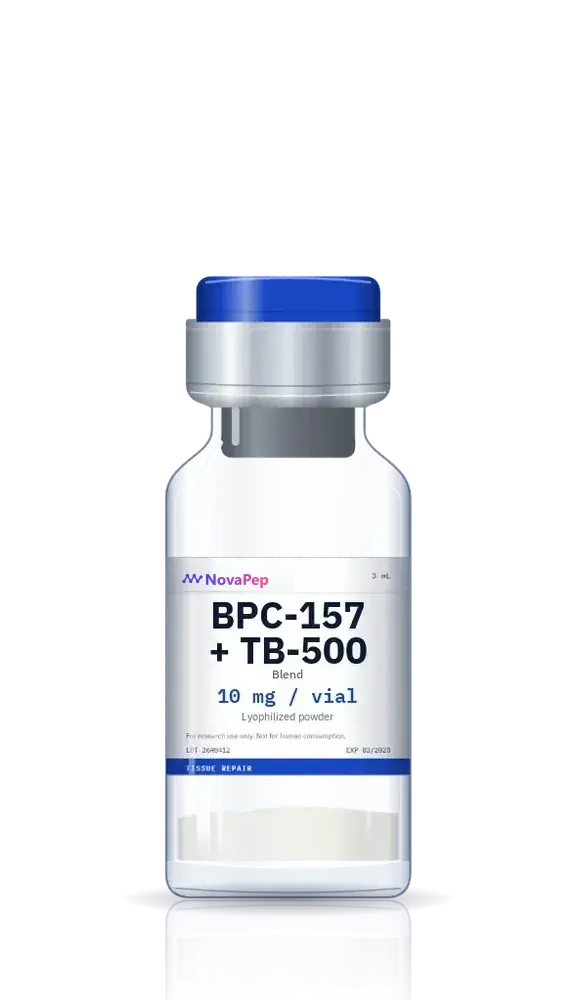
What arrives is one 3 mL glass vial closed with a blue flip-off cap. It contains a single white freeze-dried cake in which roughly 5 mg of BPC-157 and 5 mg of TB-500 are mixed through the same powder. The two can never be divided again once filled. No third ingredient is present and no diluent accompanies it.
Checking a blend means demonstrating that two compounds are present, not one. Every lot certificate carries two mass matches, one near 1419.5 g/mol for the pentadecapeptide and one near 889.0 g/mol for the acetylated heptapeptide. An HPLC trace and the purity result sit alongside. Type the lot code from your label into the COA library to view it, preferably before the first vial is opened.
Add bacteriostatic water to the order, and take extra care with the concentration because two peptides occupy the same solution. Let the diluent run slowly down the glass and swirl rather than shaking. Using 2 mL in the 10 mg vial gives a total of 5 mg/mL, made up of 2.5 mg/mL BPC-157 and 2.5 mg/mL TB-500. For any other volume, the BPC-157 and TB-500 blend calculator displays both shares. The Wolverine blend for sale in Australia leaves our shelves by tracked post, so it reaches your bench in good condition.
Store sealed vials in their carton frozen at -20 °C and out of the light. After mixing, keep the solution at 2 to 8 °C in labelled aliquots and do not refreeze it.
There is not. The 10 mg figure is the combined fill, approximately 5 mg BPC-157 and 5 mg TB-500. Add 2 mL of diluent, for instance, and each compound sits at 2.5 mg/mL. Our blend calculator shows each share at any volume, which stops doubling mistakes creeping into your notes.
Start with one question. Will your study always hold BPC-157 and TB-500 at equal amounts? If so, the blend spares a reconstitution, eliminates a weighing error across two preparations and leaves a single certificate to track. Single vials of each deliver more material in total, so the blend is the better value path only when equal amounts already suit your design.
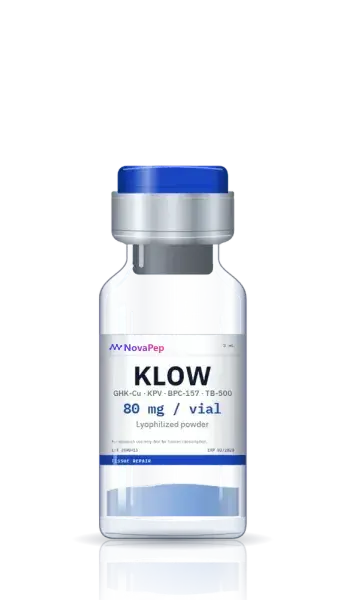
If your plan includes arms testing each compound alone, or ratios that shift, use the BPC-157 vial and the TB-500 vial on their own. Peptides dried into one cake can never be separated again. When BPC 157 and TB 500 need KPV and a copper peptide beside them, the four-component KLOW vial holds all four in one cake.
Suppliers list the same vial as TB-500 plus BPC-157 mix, BPC-157 TB-500 combo, Wolverine stack peptide or simply the Wolverine stack. All of those names describe the two compounds above at a one to one ratio. Our label states both components with their share of the 10 mg fill.
The broader vocabulary comes from each half, with pentadecapeptide and body protection compound for the first, and LKKTETQ and thymosin beta-4 fragment for the second. A request for peptides Wolverine stack with GHK Cu refers to a different three-part item. That is the GHK Cu BPC 157 TB 500 peptide blend we sell as GLOW, which adds 50 mg of copper peptide to the pair.
With two scheduled peptides in the cake, the blend inherits the restrictions attached to both. BPC-157 has been in Schedule 4 of the Poisons Standard since 1 June 2024. TB-500 along with thymosin beta-4 also carry Schedule 4 (prescription only) listings following an earlier scheduling committee review. As at October 2026 neither features in any ARTG product, so looking for BPC 157 TB 500 Australia will not reveal a registered product that a pharmacy could supply.
In sport, WADA prohibits the pair as well, BPC-157 under S0 and TB-500 under S2. The TGA's recent peptide warnings are covered in our guide to BPC-157's legal position. Anyone considering where to buy Wolverine stack Australia stock should therefore expect it to be listed only by research suppliers.
NovaPep holds the blend in Australian stock solely as a laboratory reagent for in vitro protocols, open to adults 18 and over, and never for veterinary or human use. Both components sit in our recovery peptides range, and the blend is also listed with our other premixed peptide blends. For a study running across several weeks, order every vial at once so they ship from a single lot where stock permits.
There is no need for a local stockist, even for labs hunting for peptides in Brisbane. We sell the blend online to laboratories throughout Australia, out of one local warehouse and one current lot. Anything ordered before 3pm on a business day is packed and dispatched that afternoon with tracking. Groups wondering which is the best Wolverine peptide stack can apply the two-mass test to any supplier, because a blend lacking two published mass matches is a blend nobody has checked.
Inside the vial are BPC-157, a 15-residue gastric peptide, and TB-500, a 7-residue thymosin beta-4 fragment. They remain two distinct molecules that were merely dried together.
TB-500 is studied around actin-driven cell migration and BPC-157 around new capillaries and nitric oxide, two overlapping phases of tissue repair.
Teams researching tissue repair in rodent models and cell culture use the pair to engage two pathways together. This is basic research with no proven combined effect.
Ordering each compound separately keeps you free to vary amounts and run controls. The blend locks the ratio at one to one while cutting the handling in half.
Powder goes in the freezer and solution in the fridge. With two compounds in the same liquid, work out each share separately using the blend calculator.
One sealed 10 mg vial from Australian stock, with a mass match for both peptides and HPLC purity on its certificate.
The two peptides are studied at different stages of tissue repair, TB-500 around cell migration and BPC-157 around new vessels and nitric oxide. The blend lets teams study both in parallel at a fixed ratio with fewer vials, labels and certificates. It is supplied for in vitro laboratory research only and must never be given to animals or people.
No. The 10 mg figure is the combined fill, about 5 mg BPC-157 and 5 mg TB-500. Because TB-500 is the lighter chain, that equal weight works out to roughly 1.6 TB-500 molecules for each BPC-157 molecule.
Take the blend if your protocol is locked to equal amounts of both peptides, since one vial and one reconstitution do the work of two. Take the separate BPC-157 and TB-500 vials if you need to adjust the ratio, run either compound alone or maintain single-compound controls, because a blend cannot be split.
It is. Each lot comes with its own report listing mass spectrometry matches for TB-500 as well as BPC-157, letting you verify both components are present, plus an HPLC purity figure. You will find it in the COA library under your vial's lot code, before or after purchase.
A search for "best research peptide vendors 2026 BPC 157 TB 500" returns ranked lists, many with little lab data behind them. Judge any vendor on evidence instead. Look for a lot number on the vial, a certificate showing both masses and HPLC purity, and local stock. NovaPep publishes each Wolverine Blend certificate before checkout.
Add the 10 mg vial to your cart and complete checkout here. Shipping is from Australian stock to regional and metropolitan labs alike, and anything ordered before 3pm on a business day goes out that afternoon with tracking. Delivery windows appear on our delivery information page, and buyers confirm they are 18 or older.