 NovaPep
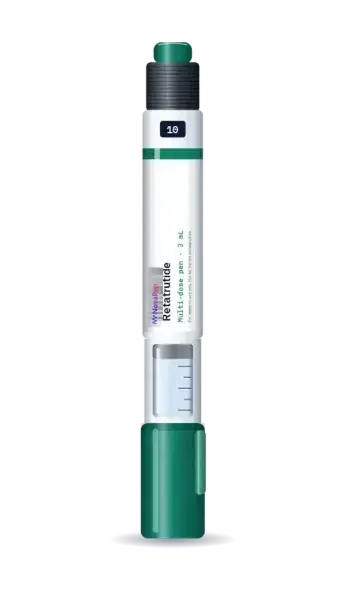
Retatrutide Pen
10 mg pen, 3 mL
$149
Research use only. NovaPep supplies research-grade peptides for laboratory and in-vitro work only, not for human or veterinary use. By continuing you confirm you are 18 or older and ordering for research.
 NovaPep
In stock in Australia, batch certificate ready
Size: 10 mg vial
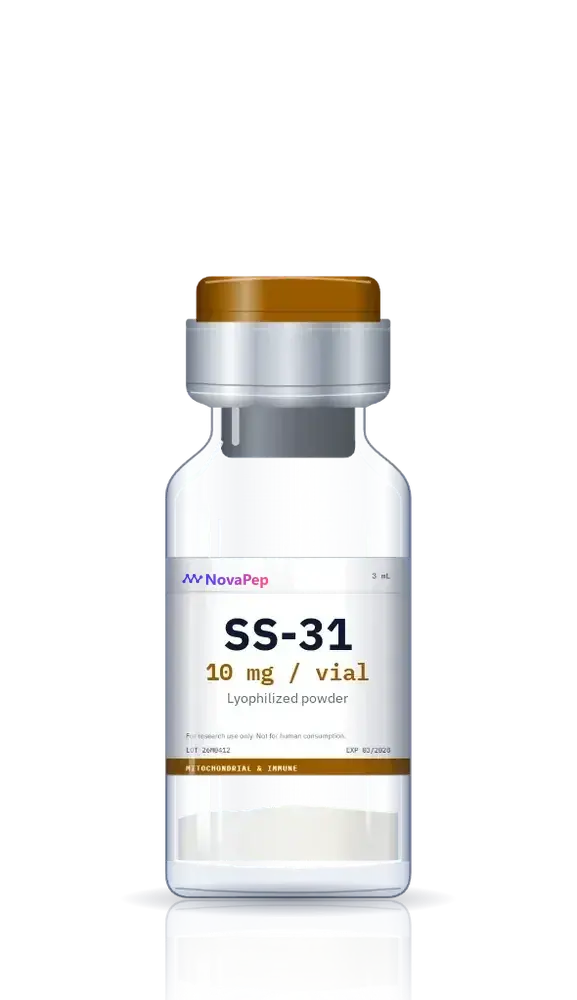
Buy SS-31 online in Australia as a 10 mg research vial of elamipretide, tested for identity and purity on every lot. SS-31 is a Szeto-Schiller tetrapeptide, also catalogued as elamipretide and MTP-131, and NovaPep supplies SS-31 online in Australia for laboratory research. Its sequence, D-Arg-Dmt-Lys-Phe-NH2, allows it to cross the cell membrane, gather within the inner mitochondrial membrane and attach to cardiolipin. Researchers use it to study how protecting that lipid changes electron transport and oxidative injury. Its identity data are C32H49N9O5, a molar mass of 639.8 g/mol and CAS 736992-21-5. It comes as a single lyophilised 10 mg vial dispatched from stock we hold locally. Each lot goes through HPLC for purity and mass spectrometry for identity, and the matching certificate of analysis can be opened before you reach checkout. For a signalling view of mitochondria, compare it with MOTS-c. No diluent is included with the powder, so pair it with bacteriostatic water and use our peptide calculator to convert the volume you pick into a working concentration. Store the unopened vial frozen at -20 °C, kept dry and away from light. NovaPep sells SS-31 strictly as a laboratory research reagent for adults 18 years and older.
For laboratory research use only. Not for human or veterinary use. Not TGA approved. See the NovaPep research use policy.
SS-31 is a synthetic peptide built from four residues. It accumulates inside mitochondria and attaches to cardiolipin, a lipid that is found in very few other places, so researchers rely on it to probe how mitochondrial membranes break down. The letters SS stand for Szeto-Schiller, the two scientists who designed it, while 31 is simply its position in their numbered series of compounds. Buy SS-31 online in Australia as a 10 mg research vial, with the lot certificate published before you order.
The Szeto-Schiller series was created in the early 2000s by Hazel Szeto and Peter Schiller, who started with opioid peptide chemistry and ended up with compounds aimed at mitochondria. SS-31 places positive charges between aromatic rings and has a net charge of +3 at physiological pH. Even so, it enters cells and collects in the inner membrane without needing a membrane potential to pull it in. That makes it well suited to studies of damaged or depolarised mitochondria, where potential-dependent probes no longer accumulate well.
Although it is short, this peptide is harder to make than it looks, for three reasons. An N-terminal D-arginine protects it from aminopeptidases, position two holds the non-natural residue 2',6'-dimethyltyrosine, and the C-terminal phenylalanine carries an amide. A product lacking any one of these could still appear as a white powder, which is why identity is proven by mass rather than by how it looks.
Cardiolipin is the part of the story that deserves a closer look. Most phospholipids have two fatty acid tails, but cardiolipin has four, and it is located almost entirely in the folded inner membrane where mitochondria generate energy. Those folds, known as cristae, need cardiolipin to bend correctly, and it also anchors the respiratory complexes that pass electrons down the chain. Cytochrome c attaches to cardiolipin as well, and this is important because the bound protein can change roles. Rather than carrying electrons, it starts to oxidise the lipid, damaging the very molecule that keeps the machinery in place. When this happens the cristae lose their shape and the membrane starts to leak.
In 2013 Hazel Szeto's group published a study in the Journal of the American Society of Nephrology, with Alexander Birk as first author. They found that a fluorescently tagged form of the peptide bound tightly to cardiolipin, and that this complex stopped cytochrome c acting as a peroxidase by covering its haem iron, while its electron transport job carried on as normal. In a model of kidney ischaemia, treated tissue kept its cristae structure. The design grew out of the group's earlier opioid analogue research, in which a related tetrapeptide called SS-02 turned out to concentrate in mitochondria, and the series was then rebuilt to keep that targeting property.
It addresses a focused and practical question. If cardiolipin, the phospholipid that holds the respiratory complexes in place, is shielded from peroxidation, how do electron transport and reactive oxygen species production change? Elamipretide has been through clinical development too, but the powder we sell is a research reagent that has no connection to any medicine. Browse the broader mitochondrial peptides collection for related research compounds. To run this kind of in vitro work, buy SS-31 online in Australia from lots tested by HPLC and mass spectrometry.
Labs misuse this compound more often than most, so two practical notes are worth making. The first is that SS-31 does not behave like a typical antioxidant, and anyone screening it as a free radical scavenger is likely to be let down. The reported effect is structural, holding a single lipid and a single protein in a fixed arrangement. The measurements that tend to reveal it are cristae shape under electron microscopy, respiratory control ratios in isolated mitochondria and lipidomic ratios of oxidised to intact cardiolipin. The second is that the peptide carries a strong positive charge, which means that at low concentrations a meaningful fraction can stick to glass and standard plastic before reaching any cells. Make fresh dilutions in low-binding tubes, otherwise the concentration on your label and the one in your well may differ.
The compound was developed through a partnership between Hazel Szeto at Weill Cornell Medical College in New York and Peter Schiller at the Clinical Research Institute of Montreal. Stealth BioTherapeutics later moved it into clinical trials as elamipretide.
In 2025 the position of elamipretide shifted. On 19 September 2025 the US FDA gave accelerated approval to Forzinity (elamipretide), making it the first treatment for Barth syndrome, an uncommon inherited condition affecting cardiolipin metabolism, and a confirmatory trial was set as a condition of that approval. The registry listing for that confirmatory trial notes that the product has no approval outside the United States. We could find no ARTG listing for it as of October 2026, which means no registered elamipretide medicine exists in Australia. The same confirmatory study lists Australia as one of the countries outside the US where it intended to recruit participants.
| Product name | SS-31 (elamipretide, MTP-131) |
|---|---|
| Size | 10 mg vial |
| Sequence | D-Arg-Dmt-Lys-Phe-NH2 (Dmt being 2',6'-dimethyltyrosine) |
| Peptide length | 4 amino acids |
| Formula | C32H49N9O5 |
| Molar mass | 639.8 g/mol |
| CAS | 736992-21-5 |
| Presentation | White lyophilised powder in a sealed 3 mL glass vial |
| Quality testing | Mass spectrometry for identity and HPLC for purity, with a certificate for every lot |
| In the box | One vial with 10 mg of SS-31, bacteriostatic water sold separately |
| Storage conditions | Sealed at -20 °C in the dark and dry, then 2 to 8 °C once in solution |
| Stock status | In stock |
| Intended use | Laboratory in vitro research only |
This vial suits projects that need a compact peptide able to enter cells and act within the inner mitochondrial membrane, rather than one that binds a receptor on the cell surface. Every 10 mg lot is held in Australia and only released for sale once it has passed both the HPLC and mass checks.
Each 3 mL glass vial has an amber flip-off cap and a white label and contains 10 mg of white lyophilised SS-31 with no other ingredients. Since the tetrapeptide has a molar mass of just 639.8 g/mol, one milligram contains roughly 3.4 times more molecules than one milligram of MOTS-c.
We stock SS-31 in one size only, a 10 mg fill. That is ten milligrams of a non-natural tetrapeptide with three modified positions. At 639.8 g/mol, the amount works out to about 15.6 micromoles, which is enough for assay setup in isolated mitochondria, a number of cell culture plates or a brief ischaemia series run by a single team.
When you open the certificate, look for a measured mass in line with 639.8 g/mol, the HPLC purity figure for the lot, the date of analysis and a lot code that matches your label. All reports are stored in our COA library and can be checked before you add the vial to your cart.
For reconstitution, allow the sealed vial to come up to room temperature, run the diluent gently down the inner wall of the glass and swirl it rather than shaking. Being small and highly charged, SS-31 goes into solution easily. Adding 2 mL of bacteriostatic water produces 5 mg/mL, which is 0.5 mg per 0.1 mL. For other volumes, the reconstitution calculator does the maths. When you buy SS-31 online in Australia, orders paid by 3pm on a business day are dispatched the same afternoon.
Keep the unopened vial at -20 °C and protected from light. Once it is mixed, transfer the solution to 2 to 8 °C, divide it into aliquots so the main vial is not punctured repeatedly, and use it up within 28 days. Cationic peptides can cling to certain plastics, so using low-binding tubes helps hold the concentration at the level you set. More detail on shelf life is in our peptide storage guide.
Choose SS-31 when your question is about the membrane, for example cardiolipin integrity, how efficiently the respiratory complexes run or oxidant leak from isolated mitochondria. Choose MOTS-c when your question is about signalling, as that 16 amino acid peptide is encoded by mitochondrial DNA and works through AMPK and nuclear gene expression.
If your redox study also needs the metabolic side covered, NAD+ makes a third arm, although it is a coenzyme and not a peptide. Each vial comes with its own lot certificate, and all of them can go in a single order. For whole-cell ageing or senescence research, our longevity peptides range has more options.
This tetrapeptide is listed and published under several labels, including SS-31, SS31 with no hyphen, elamipretide (the non-proprietary name), MTP-131 and Bendavia, which was an earlier development name. Chemistry literature may write it in full as D-Arg-2',6'-Dmt-Lys-Phe-NH2 or refer to it as a Szeto-Schiller peptide. Whatever the label, they all point to the single structure registered as CAS 736992-21-5.
The way it works brings its own set of terms, such as cardiolipin, inner mitochondrial membrane, electron transport chain, cytochrome c peroxidase activity and mitochondria-targeted antioxidant peptide. These words describe the field of research and do not refer to different products.
For a project that will run over several weeks, buy all the vials you need at the start. Where stock permits, orders of more than one vial are filled from the same lot, so the whole study is covered by one certificate and batch differences are removed from your comparisons. At checkout every buyer must confirm they are at least 18, and the peptide is sold only for laboratory research.
NovaPep has no retail shop or collection counter. We operate fully online and deliver to every Australian state and territory from local stock, sending orders out the same day when they are placed by 3pm on a business day. Delivery times are listed on our delivery information page.
None of this alters what we offer on this page. The SS-31 that NovaPep sells in Australia is a research-grade peptide. It is not Forzinity, Stealth did not make it and the TGA has not evaluated it. Our 10 mg vials are held in Australian stock and can be ordered online by adults aged 18 and over, for laboratory research only and never for human or veterinary use. Researchers buying SS-31 for membrane studies frequently add a 500 mg NAD+ vial so the cofactor part of the same redox question is covered too.
SS-31 is a four-residue synthetic peptide that enters cells, lodges in the inner mitochondrial membrane and attaches to the lipid cardiolipin.
A single sealed vial holds 10 mg of white powder. Diluent is not included, so add bacteriostatic water to your order.
Laboratories use it in isolated mitochondria, stressed cell lines and rodent ischaemia models to examine electron transport and oxidative injury, strictly for laboratory purposes.
SS-31 works directly inside the membrane, while MOTS-c is a signalling peptide coded by mitochondrial DNA that acts via AMPK.
Keep the unopened vial at -20 °C. After mixing, store the solution in the fridge as aliquots and use it within 28 days.
Each lot has its identity checked by mass spectrometry and its purity measured by HPLC, with the certificate published in the COA library.
SS-31 enters cells without needing a membrane potential and collects in the inner mitochondrial membrane. There it binds cardiolipin, the four-tailed lipid that shapes the cristae and anchors the respiratory complexes. In laboratory models this stopped cytochrome c acting as a peroxidase while electron transport carried on normally.
Yes. Elamipretide is the non-proprietary name given to the SS-31 tetrapeptide, and MTP-131 and Bendavia were earlier development codes. The vial we sell contains that sequence purely as a research reagent. It is not a medicine, no clinical claims are made for it and it is not sold for human or veterinary use.
It is a mitochondrial research tool, a peptide that enters cells, binds cardiolipin and allows researchers to examine how protecting that lipid changes electron transport, ATP production and reactive oxygen species. Published studies have used it in isolated mitochondria, cultured cells and rodent tissue, and NovaPep sells it only for in vitro laboratory research.
SS-31 works directly inside the inner membrane, so it suits questions about cardiolipin oxidation or how well the respiratory chain performs. MOTS-c is a signalling peptide encoded by mitochondrial DNA that acts via AMPK and nuclear gene expression. They tackle separate problems, so many redox projects run them side by side under the same conditions.
Put the 10 mg vial in your cart from this page and complete checkout. It ships from our Australian stock, with same-day dispatch on orders received by 3pm on a business day. Since the vial contains only powder, add bacteriostatic water to the same order, and confirm during checkout that you are aged 18 or older.
You can order it online from NovaPep no matter where your laboratory is. We have no shop or collection point, so all orders leave from the same stock in Australia and are sent with tracked delivery to every state and territory. Buying directly from us also lets you view the lot certificate before you pay, which a third-party reseller may not provide.
NovaPep
10 mg pen, 3 mL
 NovaPep
 NovaPep
2 mg vial
 NovaPep