 NovaPep
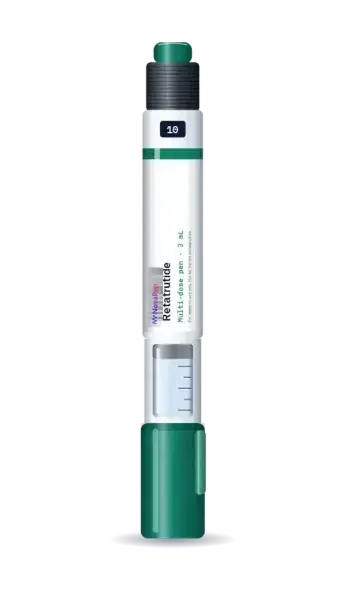
Retatrutide Pen
10 mg pen, 3 mL
$149
Research use only. NovaPep supplies research-grade peptides for laboratory and in-vitro work only, not for human or veterinary use. By continuing you confirm you are 18 or older and ordering for research.
 NovaPep
In stock in Australia, batch certificate ready
Size: 500 mg vial
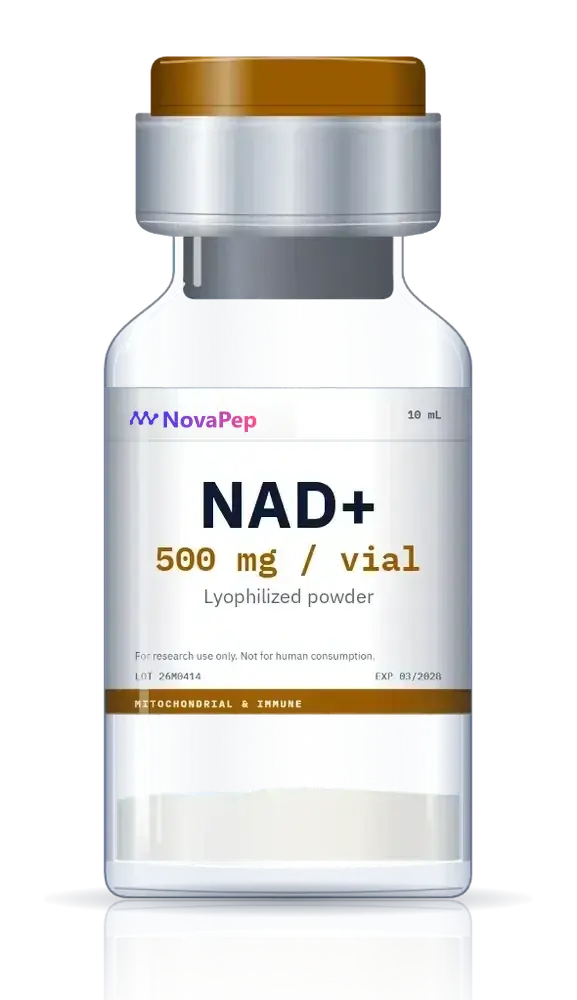
Buy NAD+ online in Australia as a 500 mg research vial of nicotinamide adenine dinucleotide, tested on every lot. NAD+ is nicotinamide adenine dinucleotide in its oxidised form, the coenzyme that carries electrons through cellular energy metabolism, supplied in Australia as a 500 mg lyophilised vial. Strictly speaking it is a coenzyme, not a peptide, with the identity C21H27N7O14P2, 663.4 g/mol and CAS 53-84-9. Sirtuins, PARPs and CD38 also consume it, which ties the coenzyme to DNA repair and gene regulation research. The vial contains NAD+ itself instead of a precursor like NMN or NR. The NAD+ 500mg fill comes in a 10 mL glass vial, which leaves the large cake space to dissolve, and ships from local stock through our online store. HPLC measures the purity of each lot and mass spectrometry confirms its identity, and the certificate is open to view before payment. Add 5-Amino-1MQ to the cart if you also want to probe the enzyme that depletes the nicotinamide pool. No diluent is included, so order bacteriostatic water, and let the peptide calculator work out the strength for any volume. Keep the sealed NAD+ vial dry and dark at -20 °C. Supplied to adults 18 and over only, as a reagent for in vitro laboratory research.
For laboratory research use only. Not for human or veterinary use. Not TGA approved. See the NovaPep research use policy.
NAD+ is a small molecule that carries electrons from the nutrients a cell breaks down to the machinery that generates energy. It also acts as the starting material for a family of enzymes involved in DNA repair and the control of gene activity. Some catalogues sell it as an NAD+ peptide, but it is in fact a nucleotide-based coenzyme containing no amino acids whatsoever. NAD+ is for sale in Australia as a 500 mg research vial, ready to order online from local stock.
Cellular energy metabolism revolves around NAD+. During glycolysis and the citric acid cycle it accepts electrons and becomes NADH, which in turn supplies the mitochondrial electron transport chain. It is also consumed as a substrate by sirtuins, PARPs and CD38, which ties its concentration to DNA repair, gene regulation and cell signalling.
Knowing the chemistry pays off before you plan an assay. NAD+ picks up electrons as a hydride, meaning two electrons plus one proton, at carbon 4 of the nicotinamide ring, and in doing so it becomes NADH while a second proton is released into solution. Because the reaction runs both ways, a single molecule can be loaded and unloaded thousands upon thousands of times, which is the whole purpose. Cells also hold the oxidised and reduced forms at intentionally different ratios in different compartments. Free coenzyme measurements place the cytosol at roughly 700 oxidised molecules per reduced one, whereas mitochondria sit closer to 10 to 1. Those ratios decide which way a particular dehydrogenase drives its reaction, so a cell-free assay must be set up with a defined ratio and not merely a defined quantity.
Shuttling electrons does not use NAD+ up, but another set of enzymes does. Sirtuins, PARPs and CD38 split the molecule in the course of their work, keeping the ADP-ribose part and freeing nicotinamide, which the salvage pathway must then turn back into new coenzyme. This breakdown is why the pool turns over quickly, and it is also what links DNA damage, during which PARP activity rises steeply, to a measurable drop in cellular NAD+. Slowing that loss from the opposite side is the rationale for the NNMT inhibitor sold as 5-Amino-1MQ.
Most products we sell were designed by someone, but nobody invented NAD+. In 1906 Arthur Harden and William John Young identified it as a heat-stable factor, named cozymase, that yeast extracts required to ferment sugar. Harden and Hans von Euler-Chelpin shared the 1929 Nobel Prize in Chemistry for research on fermentation and its enzymes, and the job the coenzyme does in carrying electrons was pieced together over the following decades. Over a hundred years later it is still among the most heavily used biochemical reagents in cell metabolism and enzyme kinetics research.
If we could pass on one point to every lab ordering this vial, it would be that the coenzyme does not cross the plasma membrane well. Put NAD+ into culture medium and ectoenzymes on the cell surface degrade much of it, after which cells absorb the smaller fragments. A study designed to raise intracellular NAD+ might actually be measuring those fragments and the receptors they activate. In cell experiments, add a nicotinamide riboside arm to tell the two routes apart, or switch to permeabilised cells or isolated mitochondria when the internal pool is what you truly want to study. None of this matters for cell-free enzyme kinetics, where the coenzyme is as well behaved as any reagent you own. Shop NAD+ online in Australia for this research, knowing each lot has been checked for identity and purity.
This vial provides a known quantity of the oxidised coenzyme on its own, with no blend. Findings obtained with precursors like NMN, NR or nicotinamide do not carry over directly, because cells have to convert those into NAD+ first. This is a research reagent and neither a supplement nor a medicine, and our longevity peptides range shows compounds frequently bought with it.
| Product name | NAD+ (nicotinamide adenine dinucleotide, oxidised form) |
|---|---|
| Fill | 500 mg vial |
| Structure | Dinucleotide of nicotinamide riboside and adenosine joined by a pyrophosphate bridge, a coenzyme and not a peptide |
| Formula | C21H27N7O14P2 |
| Molecular weight | 663.4 g/mol |
| CAS | 53-84-9 |
| Appearance | Lyophilised powder inside a sealed 10 mL glass vial |
| Quality checks | HPLC for purity and mass spectrometry for identity, with a certificate published for every lot |
| In the box | One 10 mL vial containing 500 mg of NAD+, with bacteriostatic water purchased separately |
| Storage conditions | Sealed vial at -20 °C, dry and kept from light, with solution at 2 to 8 °C |
| Stock status | In stock |
| Intended use | In vitro laboratory research only |
The vial is visibly larger than others in our metabolic range. The NAD+ 500mg fill comes in a 10 mL glass vial with a flip-off cap, containing a white to off-white solid made up of the oxidised coenzyme alone, with no precursor, peptide or filler added. That solid is hygroscopic and pulls moisture out of the air, so the vial should stay sealed and frozen right up to the day you dissolve it.
The generous 500 mg NAD+ fill suits enzyme assays and cell media projects that use a lot of coenzyme. It is held in stock, tested lot by lot and fully documented before it is sold.
The 10 mL glass is intentional. A 500 mg cake needs space for enough diluent to dissolve completely, and the bigger vial lets you prepare a concentrated stock right inside it instead of moving powder around, which reduces handling losses and the chance of contamination.
Two nucleotides make up the molecule, linked by a pyrophosphate bridge. One bears nicotinamide, the reactive end that takes on electrons, and the other bears adenine. NADH absorbs at 340 nm but oxidised NAD+ does not, a difference that underpins many enzyme assays and gives a fast way to check which form is in your hands. Reading a fresh stock on a spectrophotometer at 260 nm and 340 nm reveals whether any of the coenzyme was reduced while being handled.
Your certificate should list a measured mass in line with 663.4 g/mol, the CAS number 53-84-9 and the HPLC purity for the lot. All reports are posted in the COA library under the code printed on the vial.
Even this large fill goes into solution easily. Bring the vial to room temperature, run bacteriostatic water down the inside of the glass and swirl until it turns clear. Adding 5 mL to the 500 mg vial produces 100 mg/mL, roughly 150 mM, which makes a handy stock for diluting into assay buffer. NAD+ for sale in Australia leaves our shelves by tracked post, so it reaches your bench in good condition.
Store the sealed NAD+ vial frozen at -20 °C, dry and in the dark. Dissolved NAD+ is less stable than the powder, especially at alkaline pH, so keep the stock in small aliquots at 2 to 8 °C, shielded from light, and finish it within 28 days.
These two act on the same pool from opposite directions. NAD+ provides the coenzyme straight away, whereas 5-Amino-1MQ inhibits NNMT, the enzyme that methylates nicotinamide and pulls it out of the salvage route used to rebuild NAD+. Use NAD+ when an assay needs cofactor in the medium, 5-Amino-1MQ when the question centres on preserving recycling, and both to set the two side by side in one design.
People raise the GHK-Cu peptide vs NAD+ comparison because both appear in longevity ranges, but they are very different reagents. GHK-Cu is a tripeptide that binds copper and is studied in cell culture for gene expression and matrix research, while NAD+ is a redox coenzyme. Labs running NAD copper peptides projects with NAD+ and GHK-Cu together generally treat them as separate arms instead of combining them in one solution.
NAD peptide benefits for skin remain a purely laboratory subject, examined through NAD+ levels and sirtuin activity in cultured keratinocytes and fibroblasts, and our peptides for skin guide reviews that bench literature. Comparing NAD vs collagen peptides pits a redox coenzyme against hydrolysed protein fragments, so any NAD collagen peptides study in skin cell culture treats them as separate arms, each with its own controls.
When the interest is signalling rather than supply, MOTS-c works through AMPK, the energy sensor of the cell, and SS-31 acts on the inner mitochondrial membrane. Either one fits neatly into an NAD+ Australia order planned around mitochondrial research.
You may see it listed as NAD+, NAD, beta-NAD, nicotinamide adenine dinucleotide or under the older name diphosphopyridine nucleotide (DPN). Certain sellers label it an NAD peptide and promote the best NAD+ peptide available, even though the molecule has no amino acids, and CAS 53-84-9 refers to the oxidised form.
Compounds that are related yet distinct include NADH, the reduced form, NADP+, the phosphorylated relative used in biosynthesis, NMN, nicotinamide mononucleotide, and NR, nicotinamide riboside. Every one of these is its own molecule with separate identifiers, so read the CAS number on a label before treating two products as interchangeable.
Being a natural metabolite and not an engineered drug, NAD+ has a long history as a catalogue chemical, and labs have sourced it from reagent suppliers for many decades. This vial falls into the same class. It is not a registered medicine or a listed supplement, and the TGA has not evaluated it. NovaPep keeps the 500 mg vial in Australian stock for online purchase by adults 18 and over, solely for in vitro research and never for human or veterinary use. Groups that buy NAD+ in Australia for mitochondrial projects often include SS-31, the peptide that binds cardiolipin, as a second arm.
We stock one size, 500 mg, equal to about 750 micromoles of coenzyme. Because enzyme assays and media supplementation commonly require millimolar levels, one vial can feed several stock solutions drawn from a single lot. The large fill keeps the cost per milligram low, keeping even high millimolar assays affordable over an entire run of plates.
For a first order one vial is normally plenty, since reconstituted solution should be finished within a few weeks. Only buy a second vial from the same lot, where stock permits, once a follow-up experiment is actually scheduled, so that both runs sit under one certificate. Anyone ordering NAD+ must be at least 18.
Searching for NAD+ near me? NovaPep has no counter to walk up to. You order online and we ship from Australian stock to each state and territory, whether the lab is buying research peptides in Sydney or sits out in Kalgoorlie. Payment before 3pm on a business day gets same-day dispatch, and you can follow the parcel on our order tracking page.
This is oxidised nicotinamide adenine dinucleotide, a key player in redox reactions that sirtuins, PARPs and CD38 consume.
A single 10 mL vial holds 500 mg of powder, and bacteriostatic water is purchased separately.
Suited to enzyme assays, redox chemistry and cell media studies that call for the coenzyme itself, strictly in vitro.
NAD+ delivers the cofactor directly, and 5-Amino-1MQ guards the pathway that recycles it inside the cell.
Keep the sealed vial frozen in the dark, then refrigerate the solution in aliquots and use it within 28 days.
Each NAD+ lot undergoes mass spectrometry and HPLC, and the certificate is published in the COA library.
Put the 500 mg vial in your cart from this page. It leaves from Australian stock, and if payment reaches us before 3pm on a business day it is dispatched that afternoon. We ship to every state and territory with no shopfront, so every buyer gets the same lot certificate, which you can read beforehand. Bacteriostatic water for mixing is a separate product.
NAD+ accepts electrons as a hydride during glycolysis and the citric acid cycle, becoming NADH, which feeds the mitochondrial electron transport chain. Separately, sirtuins, PARPs and CD38 split NAD+ as a substrate, so the pool is constantly rebuilt through the salvage pathway.
Strictly, it is not a peptide. NAD+ is a dinucleotide coenzyme of 663.4 g/mol that contains no amino acids, and it is sold alongside peptides and occasionally described as one. For enzyme work the key points are the oxidised form, a verified mass and the HPLC result, and the lot certificate shows all three before you buy.
Yes. Before release, each lot is checked by HPLC for purity and by mass spectrometry for identity. You will find the certificate in our COA library under the lot code on the vial label, so it can be reviewed before purchase and stored with your study records.
Buy NAD+ if the assay needs the coenzyme present in solution. Buy 5-Amino-1MQ if you want to inhibit NNMT and preserve the salvage route that regenerates NAD+ within cells. Getting both allows a single design to compare providing the cofactor against conserving it, with delivery dates that match.
Yes, you can place both in one cart, and many labs run them as separate arms of a shared design. GHK-Cu is a tripeptide that binds copper and NAD+ is a redox coenzyme, so each is dissolved and stored on its own instead of being mixed into one solution. Both come with their own lot certificate.
NovaPep
10 mg pen, 3 mL
 NovaPep
 NovaPep
2 mg vial
 NovaPep