 NovaPep
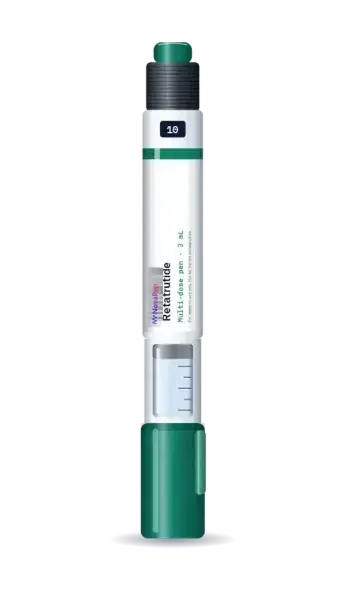
Retatrutide Pen
10 mg pen, 3 mL
$149
Research use only. NovaPep supplies research-grade peptides for laboratory and in-vitro work only, not for human or veterinary use. By continuing you confirm you are 18 or older and ordering for research.
 NovaPep
In stock in Australia, batch certificate ready
Size: 50 mg vial
Buy 5 Amino 1MQ Australia stock online from NovaPep as a 50 mg research vial, tested for identity and purity on every lot. 5 Amino 1MQ is 5-amino-1-methylquinolinium, a small quinolinium cation (C10H11N2+, roughly 159 g/mol) that laboratories use to block nicotinamide N-methyltransferase (NNMT) within intact cells. Strictly speaking it is not a peptide at all, and it is studied for how NNMT inhibition shifts NAD+ recycling and methyl balance in fat and muscle cells. Each lot has its identity confirmed by mass spectrometry and its purity measured by HPLC, and you can open the matching certificate of analysis before you pay. Pair it with NAD+ if you want to link NNMT blockade to the cofactor it protects. No solvent comes in the box, so pick up bacteriostatic water separately. Store the unopened vial cold, dry and away from light, at -20 °C for long periods. It sits within our metabolic peptides collection, sold as a lab reagent to adults aged 18 or older for in vitro research use only.
For laboratory research use only. Not for human or veterinary use. Not TGA approved. See the NovaPep research use policy.
In plain terms, 5-Amino-1MQ is a compact research chemical that shuts down NNMT, an enzyme that consumes nicotinamide inside the cell. Scientists use it to watch how adipocytes and muscle cells respond once that enzyme is no longer active. Many sellers label it the 5 amino 1MQ peptide, yet it is one ring-shaped molecule and not an amino acid chain. That difference matters for how it acts in any experiment. Buy 5-Amino-1MQ online in Australia as a 50 mg research vial, with the lot certificate published before you order.
We list it alongside our research peptides since it arrives in an identical vial, but in chemical terms 5-Amino-1MQ is a small aromatic cation that contains no amino acids whatsoever. Despite its fixed positive charge, its modest size still allows it through cell membranes. That feature is what first attracted interest in the methylquinolinium family.
Structurally it is a quinoline ring with a methyl on the ring nitrogen, which fixes the positive charge. An amino group at position 5 governs how it sits in the NNMT active site. Because it ships as a salt, the mass on the balance includes the counter-ion as well as the active cation.
The molecule grew out of university medicinal chemistry, not a pharmaceutical development pipeline. A team at the University of Texas Medical Branch in Galveston studied several methylquinolinium compounds as NNMT blockers. They chose 5-amino-1-methylquinolinium as the analogue to take into mouse and cell experiments.
The reason to inhibit NNMT becomes clear when you trace where nicotinamide goes. Signalling enzymes such as PARPs and sirtuins consume NAD+, and each reaction leaves nicotinamide behind. The bulk of it is recycled through the salvage route, in which NAMPT converts it to NMN and then back into NAD+. To run this kind of in vitro work, buy 5-Amino-1MQ online in Australia from lots tested by HPLC and mass spectrometry.
NNMT draws on that very same supply. It attaches a methyl group donated by SAM, the main methyl source in the cell, and once methylated the nicotinamide can no longer be reused. An active NNMT therefore depletes two reserves together. One is the nicotinamide that could have regenerated NAD+, the other is the SAM that feeds methylation of histones and DNA.
In enzyme terms, NNMT transfers a methyl group from S-adenosylmethionine (SAM) to nicotinamide, yielding S-adenosylhomocysteine (SAH) and 1-methylnicotinamide (1-MNA). The enzyme is highly expressed in adipose tissue and liver, and that is where most preclinical 5-Amino-1MQ research has focused. By blocking it, 5-Amino-1MQ is used to ask how a cell's NAD+ recycling and methyl balance change once NNMT is switched off.
Interest in the enzyme came before any compound existed. Back in 2014, Barbara Kahn's group at Beth Israel Deaconess and Harvard reported in Nature that NNMT levels climb in the liver and white adipose tissue of diabetic and obese mice. Silencing the gene in those tissues shielded the animals from diet-induced obesity by lifting their energy expenditure. Both NAD+ and SAM in fat rose when NNMT was reduced.
That finding prompted chemists to hunt for a drug-like blocker, which led to the methylquinolinium series from Galveston. The landmark paper came from the University of Texas Medical Branch, published in Biochemical Pharmacology in 2018. It described NNMT inhibitors able to cross membranes in mice made obese by diet.
In the obese-mouse paper of 2018, treated mice shed body weight and white fat across 11 days while eating the same amount of food. Their adipocytes shrank, which the authors interpreted as greater fat utilisation rather than lower intake. Any 5 amino 1MQ benefits described in that body of work are preclinical findings from mice and cultured cells. There are no published human trials, and the compound has no link to any approved medicine.
A practical tip is to measure NNMT in your model first. Levels differ hugely from one cell type to the next, and even between differentiated and undifferentiated cultures of a single line. Treating cells that barely express the enzyme gives a flat response that tells you nothing about the inhibitor. Run qPCR or a western blot to confirm expression first.
After that, quantify 1-methylnicotinamide, the direct enzyme product, by LC-MS as your marker of target engagement. NAD+ itself shifts with medium and cell density, which makes it an unreliable lead readout when used alone.
The published record is small and preclinical. The gene-silencing work showed what losing NNMT does in obese mice. The 2018 inhibitor work showed that a membrane-permeable NNMT blocker could shift body weight and white fat in diet-induced obese mice. Neither tells you how a given cell line will respond, because that depends on how much NNMT the cells express. Treat each new model as its own question and confirm target engagement before reading downstream metabolic changes.
| Compound | 5-Amino-1MQ (5-amino-1-methylquinolinium) |
|---|---|
| Size | 50 mg vial |
| Structure | A methylquinolinium cation carrying an amino group at position 5, provided as a salt. It is a small molecule with no peptide bonds and no amino acids |
| Formula | C10H11N2+ (cation) |
| Molar mass | Roughly 159 g/mol for the cation, with the exact salt form listed on the certificate |
| Physical form | Dry solid sealed in a glass vial |
| Lot testing | Identity by mass spectrometry and purity by HPLC, recorded on a certificate for each lot |
| In the box | A single vial containing 50 mg of 5-Amino-1MQ, no solvent supplied |
| Storage | Unopened vial kept dry and dark at -20 °C for long holding, made-up stock at 2 to 8 °C |
| Stock status | In stock |
| Intended use | In vitro laboratory research only |
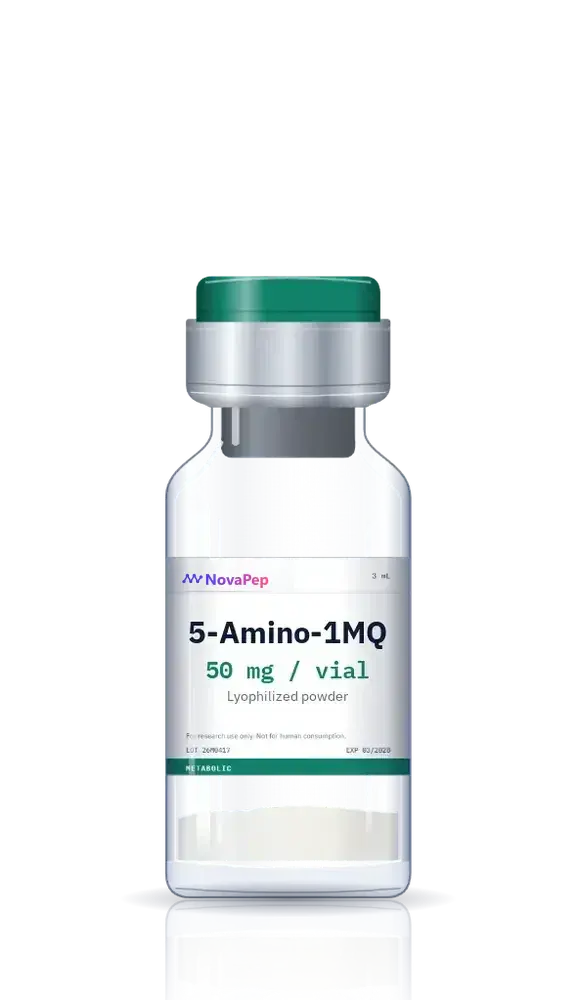
Physically, one vial arrives with a white label and a green flip-off cap, containing 50 mg of dry salt. Nothing liquid, no peptide and no blended carrier is inside. The counter-ion contributes part of the weighed mass, so each lot certificate states the salt form. Use that figure rather than the bare cation when turning milligrams into a molar stock.
On the certificate, check for the cation peak close to 159 on the mass spectrum, the declared salt form and the HPLC purity figure for your lot. Because working concentrations sit in the micromolar range, a single 50 mg fill stretches a long way.
No solvent is included, so order one on its own. A common choice is bacteriostatic water. Allow the vial to warm to room temperature, add the liquid and swirl gently until it turns clear. Adding 5 mL to the 50 mg vial produces 10 mg/mL, and our general concentration calculator works out any other volume. When you buy 5-Amino-1MQ online in Australia, orders paid by 3pm on a business day are dispatched the same afternoon.
When converting to molarity, base the sum on the full salt mass shown on the certificate and not the cation on its own. Otherwise every dilution downstream will be wrong.
Hold the unopened vial at -20 °C, dry and shielded from light, for long storage. After dissolving, keep the stock at 2 to 8 °C away from light and finish it within 28 days. Leave any powder you do not yet need in its dry state. As a stable small molecule, the compound keeps well in dry form, so a sealed backup vial from the same lot suits replication runs later in the year.
These two act at opposite ends of the same pathway. 5-Amino-1MQ inhibits the enzyme that pulls nicotinamide out of the recycling loop, whereas NAD+ is the coenzyme itself, supplied directly. Choose 5-Amino-1MQ to explore what happens when the salvage route is preserved, and NAD+ when the medium needs the cofactor. Using both sets the two strategies against each other in one design.
If you want a receptor-level view of the same metabolic programmes, SLU-PP-332 is a further small molecule that activates the estrogen-related receptors. AOD-9604 gives a peptide-based route into adipocyte metabolism. Many labs test the ERR agonist SLU-PP-332 beside this NNMT inhibitor, so a nuclear receptor agonist and an enzyme inhibitor share a single plate.
You may see it written as 5-amino-1MQ, 5amino1MQ, 5-amino 1MQ or 5 amino 1 MQ, and in full as 5-amino-1-methylquinolin-1-ium or 5-amino-1-methylquinolinium. Salt versions carry an extra word such as iodide. Some retailers call it 5 amino 1MQ peptide even though it contains no peptide bonds. Its target enzyme, nicotinamide N-methyltransferase, is shortened to NNMT.
We could not find any regulator that has approved 5-Amino-1MQ as a medicine. As at October 2026 no product containing it appeared on the Australian Register of Therapeutic Goods. In practice that means no TGA evaluation, no pharmacy supply and no prescription form exists. The compound can only be obtained from a chemical supplier as a laboratory reagent, which is exactly how research groups source it.
NovaPep holds the 50 mg vial in stock within Australia, ready to order online by adults 18 and over. We supply it purely for in vitro work and never for veterinary or human use. One size suits almost every buyer, since a single 50 mg fill typically lasts through an entire run of cell experiments. For long screens or studies spread across several sites, place every vial in one checkout so they come from one lot where stock permits.
Every report is filed in the COA library under the lot code printed on the label, and can be downloaded before or after you buy. Any lot that fails its specification is pulled from sale, never sold at a discount. NovaPep trades online only and ships from Australian stock nationwide, whether to a city lab ordering peptides in Newcastle or a regional university campus. Pay by 3pm on a business day and your vial leaves the same day, with carrier options on our delivery information page.
Pick 5-Amino-1MQ when you want to see the effect of blocking NNMT so nicotinamide stays available for recycling. Pick NAD+ when the assay calls for the coenzyme itself. Buying both allows a single design to weigh protecting the salvage pathway against adding the end product directly.
In most cases it covers a whole programme. NNMT inhibitor work in culture uses micromolar concentrations, and a cation near 159 g/mol gives a large number of micromoles per milligram. Make up only the stock needed for the next few weeks, keep the remainder dry and frozen, and one vial supports repeat series from a single lot.
A methylquinolinium cation near 159 g/mol that inhibits nicotinamide N-methyltransferase in intact cells. It is not a peptide.
Blocking NNMT keeps nicotinamide and SAM available, so cells can recycle NAD+ and maintain methylation.
Investigated for methyl balance, NAD+ salvage and adipocyte metabolism in published mouse and cell culture work.
It preserves the recycling pathway instead of adding the coenzyme, so the two suit side by side comparisons.
Unopened vial frozen, dry and dark, made-up stock refrigerated and finished within 28 days.
A single sealed 50 mg vial from Australian stock, with the salt form and HPLC and mass spectrometry results on its certificate.
It is not a peptide. The compound is 5-amino-1-methylquinolinium, a small aromatic cation weighing about 159 g/mol and provided as a salt, containing no peptide bonds or amino acids. We list it next to research peptides because it uses the same vial format and is handled much the same way in the lab.
It inhibits nicotinamide N-methyltransferase (NNMT), the enzyme that uses SAM to methylate nicotinamide into 1-methylnicotinamide. With NNMT blocked, more nicotinamide stays available for the NAMPT salvage route back to NAD+, and less SAM is consumed. Researchers track 1-methylnicotinamide by LC-MS as the marker of target engagement.
Put the 50 mg vial in your cart from this page. Orders ship from stock held in Australia, and any payment that clears by 3pm on a business day is dispatched that same afternoon with tracking. You can read the lot certificate beforehand, and solvents like bacteriostatic water are bought as a separate line. We have no shopfront, so every parcel is packed from the same local stock.
It is. Each lot is tested by HPLC for purity and by mass spectrometry for identity, and the certificate records the salt form too. You will find it in our COA library listed under the lot code on the vial, so it can be checked before ordering and saved for your records.
NovaPep offers no 5 Amino 1MQ dosing guidance, because the compound is a research reagent and not for human or animal use. We cannot suggest a 5 Amino 1MQ dose for any person. In cell work, labs set concentrations from the published NNMT literature, and the peptide calculator turns the 50 mg vial and a diluent volume into mg per mL.
Before and after photos online are not research data, and NovaPep does not use them. The published work comes from cell culture and mouse studies of NNMT inhibition in fat cell metabolism. No human trials have reported safety data, so effects in people are unknown. The compound is supplied for in vitro research only.
NovaPep
10 mg pen, 3 mL
 NovaPep
 NovaPep
2 mg vial
 NovaPep