 NovaPep
Retatrutide Pen
10 mg pen, 3 mL
$149
Research use only. NovaPep supplies research-grade peptides for laboratory and in-vitro work only, not for human or veterinary use. By continuing you confirm you are 18 or older and ordering for research.
 NovaPep
In stock in Australia, batch certificate ready
Buy AOD 9604 peptide Australia stock online from NovaPep. Our AOD 9604 Australia range comes in 5 mg and 10 mg research vials, and every AOD-9604 Australia lot is tested for identity and purity. AOD 9604 peptide is a 16 amino acid analogue of the C-terminal tail of human growth hormone, with a tyrosine placed ahead of residues 177 to 191 and a disulfide bridge forming a small loop. Developed at Monash University in Melbourne, it is studied for lipolysis and lipogenesis in adipose models, apart from the growth actions of the full hormone. We hold it in Australian stock in 5 mg and 10 mg lyophilised vials, one of the most recognised items in our metabolic peptides collection. Check each lot against its identity data, C78H123N23O23S2, 1815.1 g/mol and CAS 221231-10-3. Every lot has its identity confirmed by mass spectrometry and its purity measured by HPLC, and you can open the certificate of analysis before checkout. If your lab also explores adipocyte metabolism through an enzyme pathway, add 5-Amino-1MQ to the same order. The vial ships as dry powder, so pick up bacteriostatic water or 0.6% acetic acid as well. Keep the sealed AOD-9604 vial dry and dark at -20 °C. Supplied as a laboratory reagent to customers aged 18 or older, for in vitro research only.
For laboratory research use only. Not for human or veterinary use. Not TGA approved. See the NovaPep research use policy.
AOD 9604 is a brief synthetic peptide modelled on the final segment of the human growth hormone molecule. It was designed to find out whether that small section alone could affect fat metabolism without the growth-stimulating action of the complete hormone. The letters stand for anti-obesity drug, a tag left over from its development years and not a claim of any proven effect. You can order AOD-9604 online in Australia as a 5 mg or 10 mg research vial, and every lot ships with its own certificate.
The 16-residue chain starts with tyrosine and continues with growth hormone residues 177 to 191. Cysteines sitting at positions 7 and 14 create a disulfide bridge that forms a small loop. That loop fixes the fragment in a set shape and helps it withstand degradation. At a little over 1.8 kDa, it is a small fraction of the 22 kDa parent hormone.
With a mass of 1815.1 g/mol the peptide is light. One milligram contains roughly 2.6 times the molecules of a milligram of tirzepatide at 4813.5 g/mol, worth keeping in mind when a protocol compares them on a molar basis.
This research compound has a notably local background. Professor Frank Ng and his team at Monash University developed it during the 1990s. Their work followed research suggesting the tail of growth hormone handled the hormone's fat metabolism effects while the remainder of the molecule drove growth. Melbourne firm Metabolic Pharmaceuticals then advanced it into development, with human trials in the 2000s. It was never registered as a medicine and is still a research compound today.
Growth hormone performs two quite separate roles. Acting through the GH receptor and the IGF-1 it prompts the liver to release, it promotes tissue growth and lifts blood glucose. Independently, it prompts adipocytes to break down stored triglyceride (lipolysis) and discourages them from building more (lipogenesis). Labs planning similar studies can order AOD-9604 online in Australia, with identity and purity confirmed on every lot.
The thinking behind the AOD 9604 peptide was that these functions might live in separate regions of the 191-residue chain. On that view the C-terminal section carries the fat-related message by itself. In the lab, the fragment narrows things to one question, what this segment does in adipose tissue models without the IGF-1 stimulation produced by the full hormone.
The misconception we encounter most often is that AOD-9604 behaves like a scaled-down growth hormone. It does not. Published work found the fragment neither competed for the growth hormone receptor nor stimulated cell proliferation as the hormone did.
Preclinical literature has examined three themes. Lipogenesis is the formation of new fat, lipolysis is the release of stored fat from adipocytes, and the third is whether the fragment leaves IGF-1 levels untouched, as its creators intended. That third point is what made AOD-9604 notable. It splits a metabolic signal from the parent hormone's growth signal in a way the full protein cannot.
The most cited animal study is the 2001 Endocrinology paper by Heffernan and co-workers. Across 14 days in obese mice, the fragment and the full hormone each lowered body fat and body weight. Each also increased expression of the beta-3 adrenergic receptor, the principal lipolytic receptor on adipocytes. In mice engineered to lack that receptor, the lipolysis and weight changes were absent, although the authors judged that the fragment did not act on the receptor directly.
Clinical testing took an unusual path for a peptide, namely oral tablets. The 24-week Options trial, registered as ACTRN12605000067673, compared three daily oral dose levels against placebo. Published summaries report no statistically significant difference in weight between the groups. Whether a peptide of this size gets through the digestive tract intact is a reasonable doubt that sits over that outcome.
Metabolic Pharmaceuticals halted its obesity trials in 2007, stating they had not delivered a clinically meaningful weight result. These are research results presented neutrally, and they say nothing about using this vial.
If the fragment does not bind the GH receptor, then receptor readouts like STAT5 phosphorylation are the wrong test and will largely show nothing. In vitro, a lipolysis endpoint is more sensible, such as glycerol release from differentiated 3T3-L1 adipocytes. Use full-length growth hormone as a positive control, with a vehicle or scrambled arm alongside. That setup genuinely tests the idea the fragment was designed around.
The record splits in two. Mouse work linked the fragment to lower body fat and to higher beta-3 adrenergic receptor expression. The human trials, run with oral tablets, did not show a significant weight difference. Delivery by mouth may explain part of that gap, but the published record does not settle it. For bench work the open question is still the original one, what the C-terminal segment does in fat cells on its own.
| Compound | AOD-9604 |
|---|---|
| Sizes | 5 mg vial and 10 mg vial |
| Sequence | Tyr-Leu-Arg-Ile-Val-Gln-Cys-Arg-Ser-Val-Glu-Gly-Ser-Cys-Gly-Phe with a disulfide bridge between the two cysteines |
| Chain length | 16 amino acids |
| Formula | C78H123N23O23S2 |
| Molar mass | 1815.1 g/mol |
| CAS | 221231-10-3 |
| Physical form | Lyophilised AOD-9604 powder sealed in a glass vial |
| Lot testing | Identity by mass spectrometry and purity by HPLC, with a certificate of analysis for every lot |
| In the box | A single vial of lyophilised AOD-9604 at 5 mg or 10 mg, diluent available separately |
| Storage | Unopened vial at -20 °C, dry and dark, then 2 to 8 °C after dissolving |
| Stock status | In stock |
| Intended use | In vitro laboratory research only |
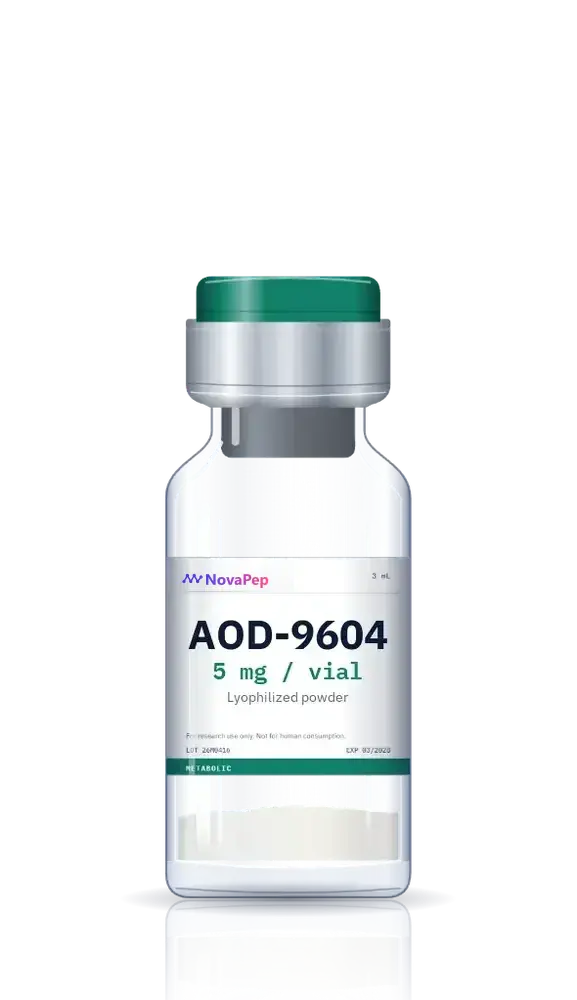
Whether you choose 5 mg or 10 mg, the vial has a white label and a green flip-off cap over a small white cake of lyophilised AOD-9604. Product names are often mixed up in this market, so it pays to understand how to read a COA. Make sure the report says AOD-9604, the measured mass lands close to 1815.1 g/mol and the lot code agrees with your label. HPLC purity is shown on each lot's report inside the COA library.
The box contains no diluent. Most researchers use bacteriostatic water, though some choose 0.6% acetic acid if the cake is slow to dissolve. For AOD-9604 reconstitution, allow the vial to come to room temperature, trickle the liquid down the inside of the glass and swirl softly. Adding 2 mL to the 5 mg vial produces 2.5 mg/mL, and the peptide calculator handles any other pairing. Order AOD-9604 online in Australia and it travels by tracked Australia Post from our local stock.
Keep the unopened vial frozen at -20 °C. Once mixed, hold the solution at 2 to 8 °C out of the light, divided into aliquots that are thawed a single time and never frozen again. Being short and stable in dry form, the fragment is often held as a frozen backup from the same lot next to the working vial. A repeat experiment months later then uses material carrying an identical certificate.
The two arrive at adipocyte metabolism along very different paths. AOD-9604 is a growth hormone peptide fragment examined for lipogenesis and lipolysis in adipose models. 5-Amino-1MQ is a small molecule that blocks the NNMT enzyme. Pick AOD-9604 when the growth hormone axis is your subject, pick 5-Amino-1MQ for an enzymatic question, or run both side by side. For a mitochondrial perspective, MOTS-c works via AMPK and sits well alongside an AOD-9604 series.
They are close relatives listed under different names. AOD-9604 is the variant developed and researched at Monash University as Tyr-hGH(177-191). Since suppliers blur the two names, verify that your label and its certificate both say AOD-9604 before you begin work.
Labels may read AOD9604, AOD 9604 or AOD-9604, and papers also use Tyr-hGH(177-191) or call it a modified hGH fragment. All of those labels point to the same 16-residue chain with CAS 221231-10-3.
HGH fragment 176-191 is a related item we list separately, and the two names get used loosely. At the receptor level the parent hormone is somatotropin, whose growth actions run mostly via IGF-1, insulin-like growth factor 1.
Neither the TGA nor any other health authority has approved AOD-9604 as a pharmaceutical. We found no sign of change as of October 2026, so no registered Australian medicine contains it. For research labs, AOD-9604 for sale in Australia is a reagent and not a medicine. NovaPep keeps both fills in Australian stock for online ordering by adults aged 18 and over, purely for in vitro research and never for veterinary or human use.
Choose the 5 mg vial for method setup, a first order or multi-compound studies needing a small amount of each. The 10 mg vial is the better value fill, halves the number of reconstitutions and keeps more of a project on a single lot. For an extended series, place several vials in one checkout and request a single lot where stock permits, so the full run is covered by one certificate.
NovaPep is purely an online store, delivering nationwide from Australian stock, so Melbourne, country postcodes and labs buying peptides in Townsville are all served from one shelf. Pay by 3pm on a business day for same-day dispatch, and see the delivery information page for service details. If you would like to buy AOD 9604 in Australia together with a compound that targets adipocyte metabolism with no growth hormone connection, the NNMT inhibitor 5-Amino-1MQ is the usual companion.
AOD-9604 gained wide public attention in 2013 through the Essendon supplements investigation. In a statement dated 22 April 2013, the World Anti-Doping Agency confirmed that AOD-9604 sits under S0, the non-approved substances section of its Prohibited List. That section captures compounds that are in development or discontinued and bans them at all times. Sport Integrity Australia, the body that replaced ASADA in 2020, enforces the same WADA list, so the compound stays prohibited for athletes covered by the code.
A 16 amino acid sequence matching growth hormone's C-terminal tail, closed with a disulfide bridge and originally made at Monash University.
Published work found it did not compete for the growth hormone receptor or drive cell proliferation like the full hormone.
Studied for lipogenesis and lipolysis in adipose models, separate from the full hormone's growth effects, in vitro only.
A hormone peptide fragment next to a small-molecule enzyme blocker, giving two paths into adipocyte metabolism.
Keep the sealed vial at -20 °C and refrigerate the made-up solution in single-use aliquots.
Lyophilised fills from Australian stock, each lot tested by HPLC and mass spectrometry on a certificate naming AOD-9604.
AOD-9604 is a 16 amino acid peptide built from growth hormone residues 177 to 191 with an added tyrosine, closed by a disulfide bridge. It was developed at Monash University to study the fat metabolism signal of growth hormone apart from its growth actions. It is supplied here as an in vitro research reagent.
Full growth hormone acts through the GH receptor and IGF-1 to drive growth. Published work found AOD-9604 did not compete for that receptor or stimulate cell proliferation. Research has instead looked at lipolysis and lipogenesis in adipose models, which is why lipolysis endpoints suit it better than STAT5 readouts.
It is. Before sale, every lot is checked by mass spectrometry for identity and by HPLC for purity. The certificate states AOD-9604, records the measured mass and is stored in our COA library under the lot code printed on your vial.
Bacteriostatic water is the usual choice, with 0.6% acetic acid preferred by some when the cake dissolves slowly. Warm the vial to room temperature, run the liquid down the glass wall and swirl instead of shaking. Adding 2 mL to the 5 mg vial yields 2.5 mg/mL, and the calculator covers other volumes.
No. AOD-9604 is supplied for laboratory research only, so NovaPep gives no dosing or administration guidance for people or animals. What we do provide is the bench maths. The peptide calculator turns the 5 mg or 10 mg fill and your water volume into a concentration.
Before and after photos posted online are anecdotes, not data, and we do not publish or rely on them. The research record is the Monash work in mouse models and the later human trials summarised above. Read those papers directly if you are planning a study, and treat every vial here as an in vitro reagent.
NovaPep
10 mg pen, 3 mL
 NovaPep
 NovaPep
2 mg vial
 NovaPep