 NovaPep
KPV
10 mg vial
$59
Research use only. NovaPep supplies research-grade peptides for laboratory and in-vitro work only, not for human or veterinary use. By continuing you confirm you are 18 or older and ordering for research.
 NovaPep
In stock in Australia, batch certificate ready
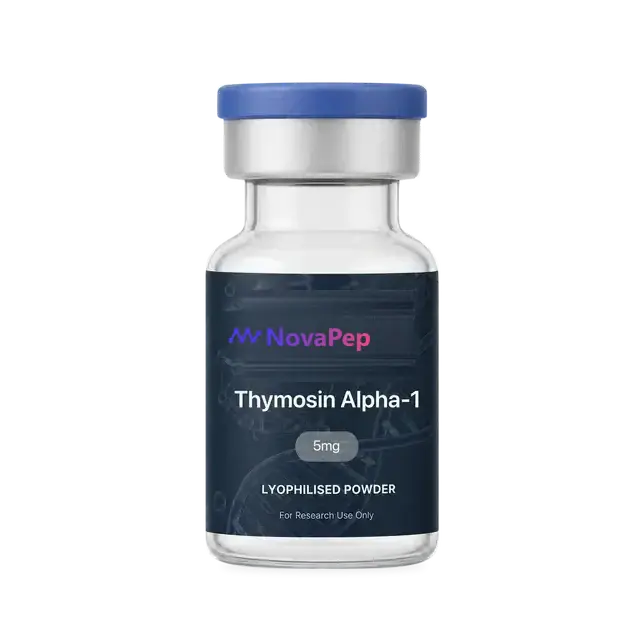
Buy Thymosin Alpha-1 online in Australia in 5 mg and 10 mg research vials of thymalfasin, tested on every lot. Thymosin Alpha-1, available online in Australia for laboratory research, is a 28 amino acid thymic peptide with an acetylated N-terminal serine, known in the literature as TA1 and by the non-proprietary name thymalfasin. It is released naturally from prothymosin alpha and is researched for its influence on dendritic cells and toll-like receptor signalling. Its identity data are C129H215N33O55, 3108.3 g/mol and CAS 62304-98-7. Mass spectrometry is run on every lot to confirm the complete acetylated chain and HPLC measures purity, and the certificate can be read before checkout. For a second thymic research tool, see Thymalin. The powder ships dry without any diluent, so combine it with bacteriostatic water and work out your concentration using the reconstitution calculator. Store the unopened vial at -20 °C. NovaPep sells it as a research reagent to buyers aged 18 years or older.
For laboratory research use only. Not for human or veterinary use. Not TGA approved. See the NovaPep research use policy.
Thymosin alpha 1, commonly abbreviated to TA1, is a small immune signalling peptide first discovered in the thymus. Researchers use it to examine how the innate sensors that detect infection go on to trigger a T cell response. In laboratory terms it is a fragment of 28 amino acids cleaved from a far larger parent protein, and the vials we sell contain a synthetic version of that fragment. You can order Thymosin Alpha-1 online in Australia as a 5 mg or 10 mg research vial, and every lot ships with its own certificate.
Allan Goldstein's group isolated Thymosin Alpha-1 from thymosin fraction 5, an extract of calf thymus, and reported its sequence in 1977. Subsequent studies traced it back to prothymosin alpha, a nuclear protein found far beyond the thymus. The chain is packed with aspartate and glutamate, giving it a strong negative charge at neutral pH, and it has no disulfide bridges.
Its parent protein, prothymosin alpha, ranks among the most acidic proteins found in mammalian cells and sits mostly in the nucleus, where it is associated with chromatin remodelling and cell proliferation. Lymphocytes and many other dividing cells produce it, not just thymic tissue. In 2003 a team in Spain reported in the Journal of Biological Chemistry that a lysosomal asparaginyl endopeptidase (legumain) cuts prothymosin alpha to free the alpha 1 fragment. This accounts for how a nuclear protein becomes a signalling peptide that behaves as if secreted.
Its receptor activity revolves around toll-like receptors, the pattern sensors dendritic cells rely on to recognise microbial material. Studies in mouse and human cells report that the peptide acts on TLR9 in plasmacytoid dendritic cells and on TLR2 in myeloid dendritic cells, prompting those cells to mature, present antigen better and secrete IL-12. IL-12 then guides naive T cells toward a Th1 profile, the branch of immunity directed against viruses and intracellular bacteria.
In the lab it addresses a focused question. How does one completely defined thymic peptide alter the way dendritic cells and lymphocytes react to a challenge? Mechanistic work implicates TLR2 and TLR9 on dendritic cells, MyD88 and NF-kB signalling, and changes in cytokines including IL-12. Under the name thymalfasin it is a registered medicine in some countries, but not in Australia, and the vial we supply is a research reagent only. Browse related compounds in our immune peptides category. Labs planning similar studies can order Thymosin Alpha-1 online in Australia, with identity and purity confirmed on every lot.
There is more human trial data for this peptide than for most research compounds, and it is not uniformly favourable. TESTS, a double-blind phase 3 trial run in 22 Chinese hospitals and published in the BMJ in 2025, randomised 1106 adults with sepsis to receive the peptide or placebo. Death at 28 days occurred in 23.4 per cent compared with 24.1 per cent, and no secondary or safety outcome differed significantly. A smaller, earlier multicentre sepsis study called ETASS, published in 2013 with 361 patients, had found 26.0 versus 35.0 per cent mortality without reaching statistical significance, so the bigger trial resolved what the first had left uncertain.
A practical caution for anyone running TA1 in dendritic cell or macrophage assays. Bacterial endotoxin (LPS) activates TLR4 and can raise IL-12 and maturation markers all by itself. Even a trace of endotoxin in any reagent, whether peptide or buffer, can create precisely the signal you hope to see. Test the working solution for endotoxin, or add a polymyxin B arm to neutralise LPS, before crediting the peptide with any change in cytokines. That single control often determines whether a positive finding holds up under peer review.
Thymalfasin is marketed as Zadaxin by SciClone Pharmaceuticals. It gained its first approval in China in 1995 for chronic hepatitis B and was later registered in roughly three dozen countries, most of them in Asia. The US FDA has never approved it.
| Product name | Thymosin Alpha-1 (TA1, thymalfasin) |
|---|---|
| Sizes | 5 mg vial, 10 mg vial |
| Sequence | Ac-Ser-Asp-Ala-Ala-Val-Asp-Thr-Ser-Ser-Glu-Ile-Thr-Thr-Lys-Asp-Leu-Lys-Glu-Lys-Lys-Glu-Val-Val-Glu-Glu-Ala-Glu-Asn-OH |
| Peptide length | 28 amino acids, acetylated at the N-terminus, no disulfide bonds |
| Formula | C129H215N33O55 |
| Molar mass | 3108.3 g/mol |
| CAS | 62304-98-7 |
| Presentation | White freeze-dried powder, sealed glass vial with rubber stopper |
| Quality testing | The complete acetylated chain is confirmed by mass spectrometry and purity is measured by HPLC, with one certificate for each lot |
| In the box | A single 5 mg or 10 mg vial of Thymosin Alpha-1, with diluent available separately |
| Storage conditions | -20 °C while sealed and kept dark, then 2 to 8 °C after reconstitution |
| Stock status | In stock in both sizes |
| Intended use | In vitro laboratory research only |
Choose this reagent for immunology research on antigen-presenting cells and T cell maturation, and select the fill size that fits how long your study will run. Both vials are made to the same synthesis specification and are only released from the warehouse once a certificate is in place.
We offer two fills, 5 mg and 10 mg, and each contains the acetylated 28 residue chain as a white freeze-dried powder, with no diluent included. It is produced by solid-phase synthesis instead of being extracted from thymus, the same approach used for the commercial medicine.
The two features most worth confirming are the acetyl group on the N-terminus and the full chain length. A shortened chain, or one missing its acetylation, can still give a tidy HPLC peak, yet its measured mass will come in under about 3108 Da. Every certificate shows the mass spectrometry result alongside the HPLC purity value and the analysis date.
Because it carries so many acidic residues, the sequence comes off a reversed-phase column early and gives one main peak after a clean synthesis, whereas additional shoulders tend to indicate deletion sequences. Comparing two lot certificates next to each other is the quickest way to verify consistency across a lengthy project.
Match the lot code on your vial with its report in the COA library, and use our guide to reading a COA to locate each figure on the page.
Allow the vial to warm to room temperature before opening, add diluent slowly down the glass and roll it gently, since foaming is a sign of over-mixing. Putting 1 mL into the 5 mg vial makes 5 mg/mL, and 2.5 mL makes 2 mg/mL. The peptide calculator covers other volumes and the 10 mg fill. Order Thymosin Alpha-1 online in Australia and it travels by tracked Australia Post from our local stock.
Sealed powder keeps best at -20 °C, dry and dark. Store reconstituted solution at 2 to 8 °C, divided into aliquots so the main vial is opened as seldom as possible, and use it within 28 days. Our reconstitution guide explains every step.
Go with Thymosin Alpha-1 when you need one defined sequence with a fixed mass that can be compared directly with international studies. Go with Thymalin when your project follows the Russian bioregulator approach, in which the material started as a thymic polypeptide complex and most of the published research came from a handful of institutes.
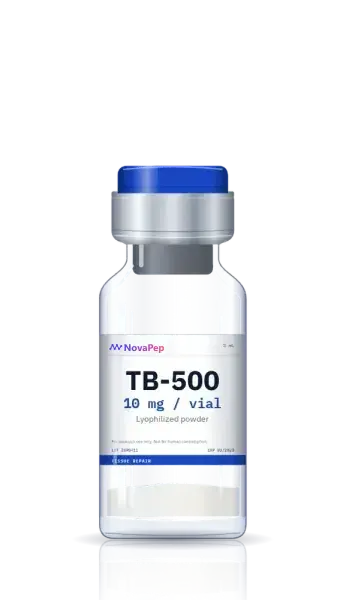
Be careful with TB-500. Despite sharing the thymosin name, it comes from thymosin beta-4, an actin-binding protein structurally unrelated to the alpha-1 chain, and it is researched in cell migration and tissue repair rather than immune signalling.
When both thymic products are used, keep each under its own certificate, so reporting every reagent's lot in your methods section is straightforward.
Suppliers and journals describe this chain in several ways, such as Thymosin Alpha-1, thymosin alpha 1 with no hyphen, TA1 and thymalfasin. Zadaxin is the brand name of the registered medicine, which NovaPep does not stock.
Associated immunology terms include prothymosin alpha (the precursor), thymosin fraction 5 (the original extract), toll-like receptors, plasmacytoid dendritic cells and Th1 polarisation. None of them refers to a separate molecule, and CAS 62304-98-7 ties them all to one sequence.
The 5 mg vial works well for pilot experiments, method development and brief cytokine assays. The 10 mg vial lowers the price per milligram and suits longer series or several plates run in parallel, provided the reconstituted solution is used up within 28 days.
Purchase all the vials a study will use in one order so they are drawn from one lot where stock permits and share a single certificate, keeping comparisons between runs clean. Making a 28 residue chain with an acetylated end calls for careful solid-phase synthesis and purification, so every lot stays on hold until its test results arrive. At checkout, buyers confirm they are at least 18.
All orders go through our online store, as we have no retail counter or click-and-collect option. Stock is kept in Australia, and orders received before 3pm on a business day leave the same day with tracked delivery to city and regional addresses.
Is Thymosin Alpha-1 legal in Australia as a reagent, then? Neither thymosin alpha-1 nor thymalfasin is named anywhere in the October 2026 Poisons Standard, so as of October 2026 neither is scheduled. Many Australians associate the word thymosin with the Essendon supplements case, where in January 2016 the Court of Arbitration for Sport found that 34 players had been given thymosin beta-4. That is an unrelated actin-binding protein and the parent of the TB-500 fragment covered in our research guide, and the Poisons Standard lists thymosin beta-4 in Schedule 4. It is easy to confuse the two when browsing Thymosin Alpha-1 listings in Australia, so confirm which chain a product actually names.
Being unscheduled does not mean being approved for therapeutic supply, which the TGA limits to products entered on the Australian Register of Therapeutic Goods. NovaPep sells Thymosin Alpha-1 from local inventory as a research reagent for laboratory use, to adults 18 and older, and not for human or veterinary use. Labs combining it with bioregulator research can put the Thymalin thymic complex in the same order.
Thymosin Alpha-1 is a synthetic version of a natural thymus peptide, 28 amino acids long, carrying an acetyl group on its first serine.
The 10 mg vial costs less per milligram than the 5 mg vial. Each holds only dry powder, so order bacteriostatic water separately.
Researchers test it on dendritic cells, lymphocytes and mouse models to see how the immune system detects and responds to a challenge, purely as a laboratory reagent.
Thymalin is an older thymic polypeptide preparation and TB-500 is derived from a completely different protein, so all three are separate products.
Store the unopened vial at -20 °C. Once dissolved, refrigerate small aliquots and use them within 28 days.
Mass analysis confirms the complete acetylated chain and HPLC gives the purity, and every lot certificate is online before purchase.
Thymosin Alpha-1 is a 28 residue peptide cut from prothymosin alpha, first sequenced by Allan Goldstein's group in 1977. In mouse and human cell studies it acts on TLR9 and TLR2 in dendritic cells. Those cells then mature, present antigen better and secrete IL-12, which steers naive T cells toward a Th1 profile.
Keep the sealed powder at -20 °C, dry and dark. After reconstitution, store the solution at 2 to 8 °C in aliquots and use it within 28 days. Let the vial reach room temperature before opening, and roll it gently rather than shaking it.
Choose Thymosin Alpha-1 when you need one defined sequence that matches the international immunology literature. Choose Thymalin when your research builds on the Russian bioregulator studies that used a thymic polypeptide preparation. Many immune projects purchase both and keep each on a separate lot certificate.
No. It is a research reagent for in vitro laboratory work, sold only to adults 18 years and older. The registered thymalfasin medicine is a different product that NovaPep does not carry, and nothing on this page is intended for human or veterinary use.
Choose the 5 mg or 10 mg vial on this page, put it in your cart and finish checkout. Both sizes are kept in Australian stock, and orders received before 3pm on a business day are sent out the same day. Add bacteriostatic water to the same order, because no diluent ships with the vial.
Yes, through the NovaPep online store, which ships tracked parcels from stock in Australia to every state and territory. We have no physical shop or collection point, so a laboratory in a capital city orders in exactly the same way as one on a regional campus, and you can read the lot certificate before paying.
NovaPep
10 mg vial
 NovaPep
10 mg vial
 NovaPep
 NovaPep
10 mg vial