 NovaPep
BPC-157
From $69
Research use only. NovaPep supplies research-grade peptides for laboratory and in-vitro work only, not for human or veterinary use. By continuing you confirm you are 18 or older and ordering for research.
 NovaPep
In stock in Australia, batch certificate ready
Size: 10 mg vial
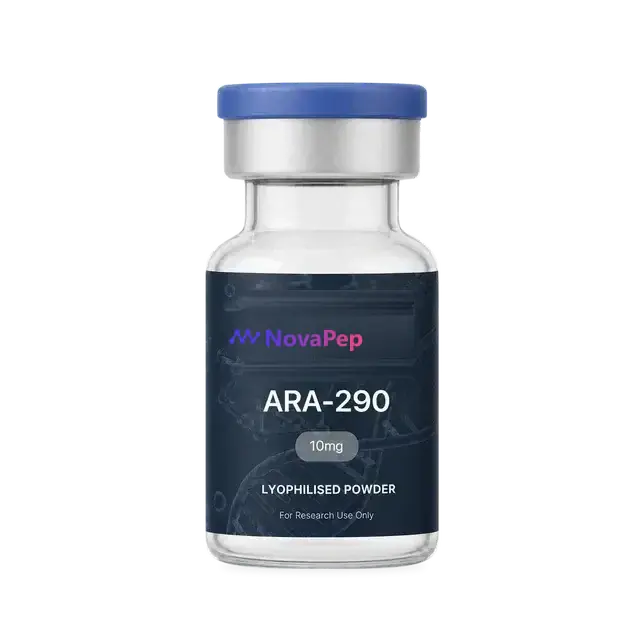
Buy ARA-290 online in Australia as a 10 mg research vial of cibinetide, tested for identity and purity on every lot. ARA-290, also called cibinetide, is an 11 amino acid peptide, pGlu-Glu-Gln-Leu-Glu-Arg-Ala-Leu-Asn-Ser-Ser, that reproduces the helix B face of erythropoietin. It was built to act at the innate repair receptor, which pairs an EPO receptor chain with CD131, while avoiding the red cell pathway of whole EPO in the models published. We supply it online from Australian stock as a single 10 mg lyophilised vial, with its lot certificate already on the site. Identity figures are C51H84N16O21, 1257.3 g/mol and CAS 1208243-50-8, and residue one should be pyroglutamate. Each lot is verified by mass spectrometry, with purity recorded by HPLC prior to release. Our peptide calculator gives you the concentration for whatever diluent volume you choose. Teams weighing up different anti-inflammatory routes frequently add KPV to the same order. Only powder is in the vial, so bacteriostatic water needs to be purchased too. Keep the sealed cibinetide vial dry, dark and at -20 °C. A research reagent for adults aged 18 and over.
For laboratory research use only. Not for human or veterinary use. Not TGA approved. See the NovaPep research use policy.
ARA-290, known also as cibinetide, is a compact synthetic peptide based on a single surface of erythropoietin (EPO). It turns on the tissue-protective side of EPO signalling while leaving the red blood cell side alone. In simple terms it is a slice of a familiar hormone, reworked so just one of that hormone's two functions survives. ARA-290 is for sale in Australia as a 10 mg research vial, ready to order online from local stock.
It is the only EPO-derived item in our catalogue. Structurally it has nothing in common with the thymic or gastric peptides shelved near it in our recovery peptides category.
Michael Brines, Anthony Cerami and colleagues tracked the protective action of EPO to its helix B face and designed a short linear peptide around it. The sequence was reported in a 2008 PNAS paper by the Brines and Cerami group, which designed short non-erythropoietic peptides from the three-dimensional structure of erythropoietin. Araim Pharmaceuticals later developed this one as cibinetide.
The chain holds two glutamates, one arginine and an uncharged pyroglutamate start. That gives a net charge around minus two at neutral pH, which influences how it retains on HPLC. At roughly 1257 g/mol it weighs only a small fraction of the EPO glycoprotein.
Two receptor arrangements carry erythropoietin's signals. On erythroid progenitors, the classic EPO receptor homodimer drives red blood cell production. A second complex, the EPO receptor joined to the beta-common receptor CD131, appears responsible for tissue protection.
EPO is a glycoprotein that folds into four alpha helices labelled A through D. Three of those handle the gripping of the classical EPO receptor pair that drives red cell production in marrow. Helix B faces away from that receptor and out into the surrounding fluid, which is why Brines and his colleagues thought it might carry the separate protective message.
The receptor they were after is the innate repair receptor, a complex assembled by cells under stress, inflammation or low oxygen. Whole EPO binds this complex much more weakly than its classical partner. Previous attempts at tissue protection using full EPO therefore needed concentrations high enough to also lift red cell output. A brief helix B mimic avoids that compromise, acting as an innate repair receptor agonist that, across the models published, leaves haematopoiesis untouched.
In the models published, the helix B mimic lowered inflammatory cytokine signalling and cell death following nerve, toxic or ischaemic injury. Researchers have applied it in animal models and cell culture covering inflammation, ischaemia and nerve injury. Shop ARA-290 online in Australia for this research, knowing each lot has been checked for identity and purity.
Internationally, cibinetide has entered small phase 2 studies, chiefly in small fibre neuropathy associated with sarcoidosis and in painful neuropathy accompanying type 2 diabetes. The best clinical evidence comes from a randomised 28-day phase 2b trial in 64 people with neuropathic pain and small nerve fibre loss associated with sarcoidosis. It was reported by Culver, Dahan and colleagues in 2017.
Corneal nerve fibre area, assessed with corneal confocal microscopy, increased significantly over placebo in one of the three active arms. Skin biopsies from that arm contained more regenerating GAP-43 positive fibres. Neither of the remaining arms separated from placebo, making the finding promising but short of a tidy dose relationship. None of that research has yielded an approved medicine.
For planning bench work, our view is that cibinetide only tells you something in a system genuinely expressing CD131. Plenty of cell lines carry the EPO receptor while showing little beta-common subunit until stressed. Include a cytokine or injury challenge in the protocol, and verify CD131 by PCR or blot before reading a null result as a failed peptide.
Molar figures become important when ARA-290 is tested against EPO in one experiment, because the peptide weighs only a small fraction of the glycoprotein. At roughly 1257 g/mol, one 10 mg vial supplies around 8 micromoles, ample for a receptor assay or an exploratory cell culture series.
Animal and cell models give a consistent picture of reduced inflammatory signalling and cell death after injury. The human record is thinner. One small phase 2b trial found a nerve fibre signal in one arm out of three, which is encouraging but not conclusive. For a lab the useful takeaway is the receptor logic. Effects should track CD131 expression, so a model lacking it makes a natural comparison arm.
| Compound | ARA-290 (cibinetide) |
|---|---|
| Size | 10 mg lyophilised vial |
| Sequence | pGlu-Glu-Gln-Leu-Glu-Arg-Ala-Leu-Asn-Ser-Ser, taken from the helix B face of erythropoietin |
| Chain length | 11 amino acids beginning with pyroglutamate |
| Formula | C51H84N16O21 |
| Molar mass | 1257.3 g/mol |
| CAS | 1208243-50-8 |
| Physical form | Lyophilised powder sealed beneath a stopper in a glass vial |
| Lot testing | Identity confirmed by mass spectrometry and purity measured by HPLC, with a certificate on file for each lot |
| In the box | One 10 mg vial of cibinetide powder per unit, no solvent supplied, bacteriostatic water available separately |
| Storage | Sealed at -20 °C, dry and dark, with the made-up solution held at 2 to 8 °C |
| Stock status | In stock |
| Intended use | In vitro laboratory research and nothing else |
Two points on the certificate are worth attention. The measured mass ought to land near 1257.3 g/mol, and the opening residue should read pyroglutamate rather than open glutamine. That difference of roughly 17 mass units exposes incomplete cyclisation.
Compounds with a short commercial track record draw more poorly produced material. A truncated sequence or an open-chain glutamine variant would appear identical as white powder. A lot-matched report settles that question before the vial arrives at your bench, and the lot code lets you state precisely which material was used when results are written up. Every line of that report is explained in our guide to reading a COA.
The vial holds a small white cake with no diluent and no companion peptide. Include bacteriostatic water in the same cart. Bring the vial up to room temperature, run the diluent gently down the glass and swirl until it clears. Putting 2 mL into the 10 mg vial gives 5 mg/mL, and our concentration calculator covers other volumes. ARA-290 for sale in Australia leaves our shelves by tracked post, so it reaches your bench in good condition.
Sealed vials keep best frozen at -20 °C and shielded from light. Once reconstituted, hold the solution at 2 to 8 °C in portions and never refreeze it.
Each is a short peptide drawn from a larger hormone and studied for anti-inflammatory signalling, yet they enter by different doors. ARA-290 acts on the EPO receptor and CD131 complex, whereas KPV, the alpha-MSH tripeptide, gets into epithelial cells via PepT1 and dampens NF-kappa B. Select ARA-290 for receptor-level tissue protection work, and KPV for skin and gut epithelium models.
Add BPC-157 for a third perspective on repair, taking in nitric oxide and growth factor pathways from rodent injury studies. Testing two or three of these compounds in parallel, each from its own vial, allows a study to map which pathway carries an effect instead of guessing from one reagent alone.
Catalogues show it as ARA290, ARA 290, ARA-290 and cibinetide, its international nonproprietary name. It occasionally appears as pHBSP or helix B surface peptide, the pyroglutamate version described in the early literature. All of those names denote the same 11-residue chain with CAS 1208243-50-8.
A set of receptor terms travels with it, including tissue-protective receptor, innate repair receptor (IRR), beta-common receptor, CD131 and EPOR. Do not confuse the peptide with EPO itself or with erythropoiesis-stimulating agents.
As at October 2026 no regulator, including the TGA, has approved cibinetide for supply, and nothing containing it appears on the ARTG. No pharmacy prescription route exists for it in Australia. Sport is the other setting where it appears, since WADA bans innate repair receptor agonists under S2.1 at all times. Earlier versions of the list cited ARA-290 as an example, a rule enforced locally by Sport Integrity Australia.
Because the candidate never gained registration anywhere, cibinetide exists in Australia solely as a research chemical. Labs buying ARA-290 from NovaPep get vials held in local stock, sold as a laboratory reagent to adults 18 and over, with human and veterinary use prohibited. This EPO-derived peptide is stocked by very few suppliers. Only one fill is offered, the 10 mg vial, which reflects a longer synthesis finishing with the cyclised pyroglutamate at the N-terminus.
Buy one vial first to check that your system responds, then order the rest of the series together so each run links back to a single lot where stock allows. Before you order, look up the pyroglutamate mass and the chromatogram on the matching report in our certificate archive, and browse the broader tissue repair peptide range for compounds working through different receptors.
All ARA-290 orders run through this online store, which serves labs across the country, including those purchasing research peptides in Canberra, from one Australian stock with no shopfront. Order by 3pm on a business day and the vial leaves that afternoon with tracking, which you can follow on the track order page. Buyers of ARA-290 in Australia often assemble a panel with KPV and BPC-157.
ARA-290 is an 11 amino acid peptide taken from one face of EPO, designed to set off the protective signalling of EPO while leaving its blood-forming role aside.
It targets the EPO receptor joined with CD131, a complex cells assemble under stress, rather than the red cell receptor pair.
Researchers apply it to the EPO receptor and CD131 complex in neuropathy, ischaemia and cell models. This is preclinical research rather than treatment.
KPV is a three-residue piece of alpha-MSH that works inside epithelial cells. ARA-290 acts at a surface receptor, so each answers a different question.
Store the sealed vial frozen and the solution refrigerated. Divide solutions into portions instead of refreezing.
One sealed 10 mg vial, tested by HPLC and mass spectrometry with the pyroglutamate start confirmed. Bacteriostatic water is sold separately.
It serves as a selective means of activating the innate repair receptor in animal models and cell culture covering inflammation, ischaemia and nerve injury. A study can therefore look at EPO-like protective signalling without blood cell effects. Supply is for in vitro and laboratory research only, never human or veterinary use.
They are not. EPO is a sizeable glycoprotein hormone that acts on two receptor complexes, one of which drives red cell production. ARA-290 is a brief peptide from just one surface of EPO, made to engage only the tissue-protective complex, and that is exactly why it is used to separate the two signals.
Keep the sealed vial frozen at -20 °C, dry and away from light. After reconstitution with bacteriostatic water, hold the solution at 2 to 8 °C, divided into portions so it is never refrozen.
Pick ARA-290 for receptor-level studies of the innate repair receptor, the EPO receptor joined with CD131. Pick KPV for inflammatory signalling within skin or gut epithelial cells, which it enters via PepT1. Researchers comparing both routes commonly buy the two vials and run them side by side.
Yes, one for every lot. Independent testing applies mass spectrometry to confirm a mass close to 1257.3 g/mol, which also demonstrates the pyroglutamate is present, and HPLC to state purity. The report carries the lot code on your vial and is viewable in our COA library before you order.
Add the 10 mg vial to your cart and complete checkout on this page. Dispatch is from Australian stock, the same afternoon when ordered before 3pm on a business day, with tracking to regional centres and capital cities alike. Add bacteriostatic water if you require diluent, and confirm you are at least 18 years old.
NovaPep
 NovaPep
10 mg vial
 NovaPep
10 mg vial
 NovaPep
10 mg vial