 NovaPep
Ipamorelin
10 mg vial
$59
Research use only. NovaPep supplies research-grade peptides for laboratory and in-vitro work only, not for human or veterinary use. By continuing you confirm you are 18 or older and ordering for research.
 NovaPep
In stock in Australia, batch certificate ready
Size: 10 mg vial
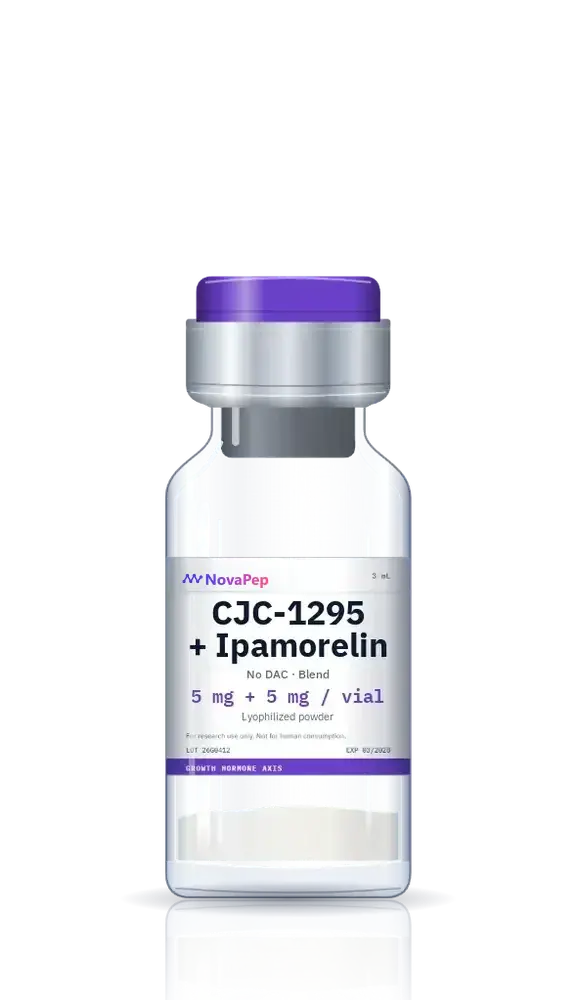
Buy CJC 1295 ipamorelin online in Australia as one 10 mg research vial holding 5 mg of each peptide, tested on every lot. CJC 1295 ipamorelin is a premixed research blend of two growth hormone secretagogues, 5 mg of CJC-1295 No DAC and 5 mg of ipamorelin freeze-dried in one 10 mg vial. It brings together Mod GRF (1-29), a GHRH receptor agonist carrying four substitutions that resist enzymes, and ipamorelin, a selective five-residue agonist at the ghrelin receptor GHS-R1a, so one preparation engages both pituitary triggers. We ship it from local stock in Australia. Component identity figures are C152H252N44O42 at 3367.9 g/mol for the GHRH analogue, and C38H49N9O5 at 711.9 g/mol with CAS 170851-70-4 for ipamorelin. Mass spectrometry checks both peptides in every lot and HPLC measures purity, and the certificate can be viewed before checkout. Our CJC-1295 ipamorelin calculator converts any diluent volume into a separate concentration for each component. To compare two GHRH analogues inside one design, add the tesamorelin and ipamorelin blend to the same order. The vial contains powder only, so include bacteriostatic water, and keep the sealed blend frozen at -20 °C. Sold as an in vitro research reagent to adults aged 18 or over.
For laboratory research use only. Not for human or veterinary use. Not TGA approved. See the NovaPep research use policy.
This research blend combines a GHRH analogue with a ghrelin receptor agonist, so one preparation engages both of the pituitary's main triggers for growth hormone release at once. The two peptides are freeze-dried as one, so you see a single white cake and not separate layers, and both dissolve together on reconstitution. Buy the CJC-1295 and ipamorelin blend online in Australia as a 10 mg research vial, with the lot certificate published before you order.
Each ingredient also has a dedicated page. The Mod GRF 1-29 single vial handles the GHRH side, while the selective ghrelin agonist on its own covers the second pathway.
Mod GRF (1-29) is a stabilised fragment ConjuChem built from the opening 29 residues of human GHRH. Ipamorelin originated at Novo Nordisk. In 1998 Novo Nordisk researchers reported it as the first GHRP to trigger growth hormone release without meaningful increases in ACTH or cortisol in the models they examined.
Nobody developed the combination as such. The pairing emerged from laboratory synergy research and later the overseas clinic market rather than a sponsored drug programme. No regulator has approved a medicine containing both.
Mod GRF (1-29) has D-alanine at position 2, glutamine at 8, alanine at 15 and leucine at 27. These swaps slow cleavage by DPP-4 and give a half-life near 30 minutes. Ipamorelin, Aib-His-D-2Nal-D-Phe-Lys-NH2, uses an unnatural aminoisobutyric acid and two D-amino acids to hold off degradation. Neither has an albumin linker, so both act for a short time and their timing matches.
Both receptors live on the same somatotroph cells yet communicate with them differently. The GHRH receptor is coupled to Gs and lifts cyclic AMP, priming the cell and building up its growth hormone reserve. GHS-R1a is coupled to Gq, freeing calcium from internal stores and switching on protein kinase C, which drives the stored granules out.
In short, one signal loads the cell and the other fires it. Agonists of the ghrelin type also work higher up in the hypothalamus, promoting GHRH release and softening the brake that somatostatin applies.
CJC-1295 No DAC has a half-life near 30 minutes, matching ipamorelin's short action and keeping the signal pulsatile. Because both components act briefly, their timing stays matched and neither hides the other. The DAC form stays bound to albumin for days and would convert a pulse design into a continuous one.
Earlier studies answered the combination question by showing a bigger release than either agonist gave separately. In 1990 Cyril Bowers and co-workers reported in the Journal of Clinical Endocrinology and Metabolism that healthy men given a hexapeptide GHRP together with GHRH released much more growth hormone than with either agent by itself. To run this kind of in vitro work, buy the CJC-1295 and ipamorelin blend online in Australia from lots tested by HPLC and mass spectrometry.
The ghrelin arm depends on GHRH tone to work fully, so models missing hypothalamic GHRH input show a sharply reduced GHRP response. The blend lets a lab study how GHRH receptor and ghrelin receptor activation combine in pituitary cells.
A 5 mg plus 5 mg split does not mean an equal number of molecules. At roughly 712 g/mol for ipamorelin and roughly 3368 g/mol for Mod GRF, 5 mg of each gives around 7.0 micromoles of ipamorelin versus 1.5 micromoles of the GHRH analogue. That is close to five ipamorelin molecules per molecule of its partner. If you report molar concentrations, or line this vial up against a paper that used equimolar amounts, do the conversion first.
Labs often ask which peptide is best to stack with CJC 1295 ipamorelin, and usually we suggest none at all. Adding a third active agent means you can no longer say which receptor caused a given change. Questions involving a third compound are better handled with single vials, keeping the blend as a constant reference arm.
| Product name | CJC-1295 and Ipamorelin Blend (CJC-1295 No DAC with ipamorelin) |
|---|---|
| Size | 10 mg vial (5 mg plus 5 mg) |
| Structures | Ipamorelin, Aib-His-D-2Nal-D-Phe-Lys-NH2, alongside Mod GRF (1-29), a GHRH (1-29) amide carrying D-Ala2, Gln8, Ala15 and Leu27 |
| Chain lengths | Ipamorelin 5 amino acids, Mod GRF 29 amino acids |
| Formulas | Ipamorelin C38H49N9O5, Mod GRF C152H252N44O42 |
| Molar masses | Ipamorelin 711.9 g/mol, Mod GRF 3367.9 g/mol |
| CAS | Ipamorelin 170851-70-4, and no verified CAS has been assigned to Mod GRF (1-29) |
| Physical form | Lyophilised powder, with both peptides inside one sealed 3 mL glass vial |
| Quality testing | Mass spectrometry identity for each peptide, HPLC purity, one certificate per lot |
| In the box | A single vial holding 5 mg CJC-1295 No DAC and 5 mg ipamorelin, no diluent (bacteriostatic water sold separately) |
| Storage conditions | Closed vial at -20 °C protected from light and moisture, reconstituted at 2 to 8 °C |
| Stock status | In stock |
| Intended use | In vitro laboratory research only |
A proper blend certificate lists two identity results, a mass close to 3367.9 g/mol for the GHRH component and one close to 711.9 g/mol for ipamorelin, along with an HPLC trace for the lot. Any lot lacking either peak is held back. Look up your report in the certificate library with the lot number from the label.
For reconstitution, let the vial reach room temperature, add bacteriostatic water gently against the glass and swirl until clear. Using 2 mL gives 5 mg/mL of total peptide, which is 2.5 mg/mL of each component. For any other volume, the blend calculator returns both numbers. When you buy the CJC-1295 and ipamorelin blend online in Australia, orders paid by 3pm on a business day are dispatched the same afternoon.
Keep the unopened powder at -20 °C in darkness. Once mixed, store it at 2 to 8 °C and finish it within 28 days, split into aliquots so the stock is spared repeated temperature changes. Our peptide storage guide explains why a solution is less stable than dry powder.
Each blend pairs ipamorelin with a GHRH analogue. This vial uses the 29 residue Mod GRF fragment in an even 5 mg plus 5 mg split. The tesamorelin and ipamorelin blend carries the complete 44 residue tesamorelin chain at 13 mg plus 3 mg, which makes its ghrelin component the smaller partner. Choose the vial whose analogue and ratio fit your protocol.
Some labs set up a three-way sermorelin ipamorelin CJC 1295 comparison, placing the native GHRH fragment next to the stabilised one while the ghrelin agonist is held constant. For that work, Sermorelin is available as a 10 mg vial. When a design needs sustained GHRH stimulation rather than a pulse, neither blend is suitable, and the long-acting DAC compound is sold separately.
Separately, CJC-1295 No DAC and ipamorelin each come as 10 mg vials. If you want to change one compound while keeping the other constant, use the single vials and set your own ratio. For a single-compound reference on the ghrelin side, see the 10 mg ipamorelin vial.
Other suppliers may label this vial as a CJC-1295 No DAC+Ipamorelin blend, ipamorelin CJC-1295 No DAC, Mod GRF and ipamorelin, or just the CJC and Ipa blend. The GHRH ingredient is also called modified GRF (1-29) or tetrasubstituted GRF (1-29), and ipamorelin is occasionally referenced by its development code NNC 26-0161.
The receptor terminology tracks the two pathways. GHRHR is the growth hormone releasing hormone receptor, while GHS-R1a, the growth hormone secretagogue receptor 1a, handles the ghrelin side. A secretagogue is simply a compound that prompts a gland to release its product.
Australia controls each ingredient separately. Under the June 2026 Poisons Standard, the instrument in force in October 2026, ipamorelin is named in Schedule 4 and Appendix D, clause 5. Mod GRF (1-29) falls within the growth hormone releasing hormones class with those same two listings. Combining them in one vial does not alter how either is handled, and neither is on the ARTG.
The TGA is also watching this market closely. On 13 April 2026 it released an advisory about the obligations of anyone importing, compounding or supplying unapproved peptide products, and its 2026 to 2027 compliance priorities now include unapproved peptides. Sport adds a second layer. The 2026 WADA list captures the GHRH analogue and the ghrelin agonist under two different headings inside class S2, growth hormone releasing factors. One vial therefore carries two substances that Sport Integrity Australia treats as banned at all times.
Researchers wanting to buy CJC 1295 ipamorelin in Australia with both identities documented will find the 5 mg plus 5 mg blend on our Australian shelf now. It is sold only to buyers who confirm they are adults aged 18 or over, and laboratory research is its only permitted use. It is listed in our peptide blends range beside the other fixed-ratio products. The blend is the better value choice whenever a method calls for just 5 mg of each at a fixed ratio, and vials ordered together come from one lot wherever stock permits.
There is no retail counter, so ordering happens online. The blend leaves one local stock for labs all over Australia, and payment cleared before 3pm on a business day means dispatch that same day. Teams sourcing research peptides in Melbourne use exactly the same process, and you can follow the parcel on the order tracking page.
A premixed vial of Mod GRF (1-29), active at the GHRH receptor, and ipamorelin, active at the ghrelin receptor. Both act briefly, so their timing lines up.
The GHRH receptor raises cAMP to build the growth hormone reserve, while GHS-R1a releases calcium to push stored granules out.
Used in lab studies of how GHRH and ghrelin receptor signals add together at the pituitary. For in vitro and laboratory research only.
The tesamorelin blend uses the complete 44 residue analogue at 13 mg plus 3 mg. This vial keeps an even split based on the 29 residue fragment.
Keep the sealed vial at -20 °C. After mixing, store at 2 to 8 °C in aliquots and use within 28 days.
One sealed vial with 5 mg of each peptide from Australian stock, with a mass result for each on the certificate in the COA library.
This research reagent supports studies of how activation of the GHRH receptor and the ghrelin receptor combines to drive growth hormone release from pituitary cells. It removes the need to prepare two vials when both peptides are used at equal weight. It is not a medicine and is supplied for in vitro and laboratory work only.
CJC-1295 No DAC has a half-life near 30 minutes, matching ipamorelin's short action and keeping the signal pulsatile. The DAC form stays bound to albumin for days and would convert a pulse design into a continuous one. Labs that want that combination can order CJC-1295 With DAC and ipamorelin as separate vials.
No. Ipamorelin weighs about 712 g/mol and Mod GRF about 3368 g/mol, so the vial holds roughly 7.0 micromoles of ipamorelin and 1.5 micromoles of Mod GRF. That is close to five ipamorelin molecules for each GHRH analogue molecule.
For lab comparisons, buyers tend to add single vials of CJC-1295 No DAC and ipamorelin to adjust the ratio, sermorelin as a native GHRH control, or the tesamorelin and ipamorelin blend to change the GHRH analogue. Each is its own research reagent with a separate lot certificate, and they can all share one cart.
Every lot has one. Mass spectrometry confirms Mod GRF (1-29) close to 3367.9 g/mol and ipamorelin close to 711.9 g/mol, while HPLC measures purity. The report sits in the COA library under the lot number printed on your vial, so both identity results can be checked before you buy.
Choose the 10 mg vial here, add it to your cart and check out. The blend leaves from a single Australian stock to all states and territories, going out that afternoon if payment clears before 3pm on a business day. Bacteriostatic water is not in the vial, so add it to the same cart, and look over the lot certificate before confirming.
NovaPep
10 mg vial
 NovaPep
10 mg vial
 NovaPep
5 mg vial
 NovaPep
13 mg + 3 mg vial