 NovaPep
Ipamorelin
10 mg vial
$59
Research use only. NovaPep supplies research-grade peptides for laboratory and in-vitro work only, not for human or veterinary use. By continuing you confirm you are 18 or older and ordering for research.
 NovaPep
In stock in Australia, batch certificate ready
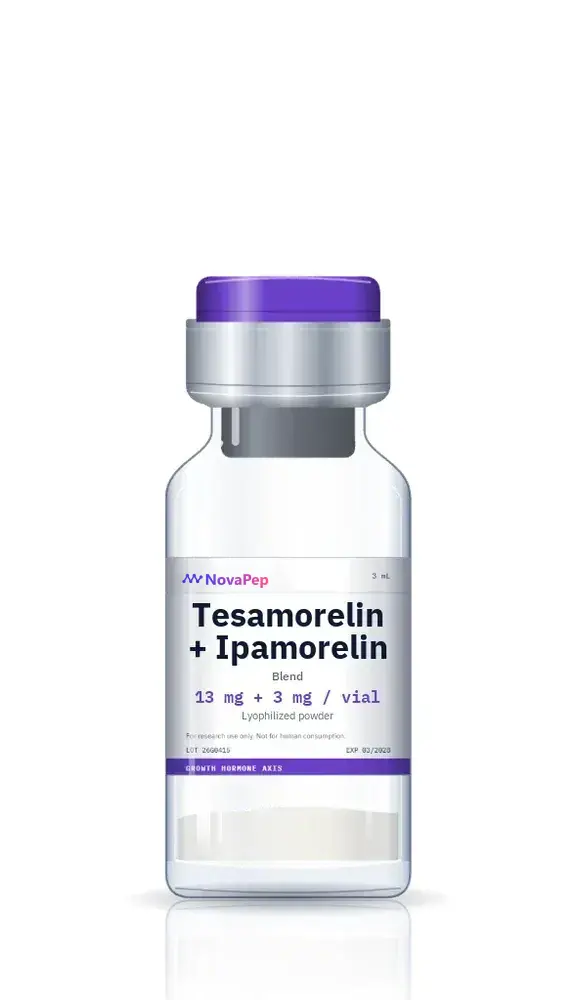
Size: 13 mg + 3 mg vial
Buy the tesamorelin ipamorelin blend online in Australia as one research vial holding 13 mg of tesamorelin and 3 mg of ipamorelin. The tesamorelin ipamorelin blend, stocked online in Australia, combines tesamorelin, the complete 44 residue GHRH analogue finished with a trans-3-hexenoyl cap, with ipamorelin, a five residue agonist of the ghrelin receptor GHS-R1a. Together they act on the two receptors that control pituitary growth hormone output, at a ratio weighted toward the GHRH partner. Tesamorelin has the formula C221H366N72O67S, a molar mass of 5135.9 g/mol and CAS 218949-48-5. Ipamorelin is C38H49N9O5 with 711.9 g/mol and CAS 170851-70-4. The blend comes as one vial holding 13 mg plus 3 mg, sent from stock we keep locally. Mass spectrometry confirms each of the two peptides in every lot and HPLC records purity, with the certificate open in the COA library before you pay. Use the tesamorelin calculator to find the main peptide's concentration once mixed. For an equal-ratio comparison based on the shorter GHRH fragment, see the CJC-1295 and ipamorelin blend. No diluent is supplied with the powder, so add bacteriostatic water too. Keep the unopened blend at -20 °C until needed. NovaPep sells it as a research reagent for in vitro work to buyers aged 18 years or older.
For laboratory research use only. Not for human or veterinary use. Not TGA approved. See the NovaPep research use policy.
Tesamorelin ipamorelin is a ready-mixed research vial that joins a full-length GHRH analogue to a small, selective ghrelin mimic, so a single solution acts on both receptors controlling pituitary growth hormone output. Most of the load falls on tesamorelin. Ipamorelin plays a supporting role, included to boost the signal rather than drive it. Each compound's chemistry is described on the tesamorelin single vial page and on the ipamorelin 10 mg listing, so this section focuses on why the two are combined. You can order the tesamorelin ipamorelin blend online in Australia as one 13 mg plus 3 mg research vial, and every lot ships with its own certificate.
The tesamorelin chain starts at the hexenoyl-capped tyrosine and ends in a C-terminal amide, and apart from that cap it is identical to the natural hormone. Ipamorelin gets its stability from aminoisobutyric acid and two D-amino acids. Longer chains give more opportunity for deletion or truncated sequences during synthesis, so pay closest attention to the tesamorelin peak when you review the report.
A somatotroph takes its growth hormone instructions through two distinct entry points. Tesamorelin activates the GHRH receptor, which signals via cyclic AMP and determines how much hormone the cell produces and how responsive it is. Ipamorelin acts at the ghrelin receptor instead, which signals through calcium and protein kinase C and triggers release of hormone already in storage. Since the two signals follow separate pathways inside the cell, they add to each other rather than compete. Human studies dating back to 1990 showed that combining GHRH with a GHRP gave a much bigger growth hormone release than either one used alone. Ghrelin agonists also oppose somatostatin, the brake from the hypothalamus, giving the GHRH signal more space to work.
The partner was picked on purpose. Clinical data on tesamorelin focus on fat distribution and lipids, and cortisol is among the most powerful drivers of visceral fat. Older secretagogues such as GHRP-6 or GHRP-2 raise cortisol and prolactin as well as growth hormone, which would cloud precisely the measurements tesamorelin is best known for. Ipamorelin mostly leaves the adrenal axis untouched, so any shift in your results can be linked to the growth hormone axis with greater certainty.
Neither peptide binds to albumin, and each is cleared over hours rather than days, which keeps the two signals broadly aligned in time instead of one persisting long after the other has gone.
Receptor names come from each half, GHRHR for tesamorelin and GHS-R1a, the ghrelin receptor, for ipamorelin. Both lead to growth hormone release from pituitary somatotrophs, and IGF-1 is the typical downstream marker.
Tesamorelin was developed by the Canadian firm Theratechnologies, which retained all 44 amino acids of human GHRH and attached a trans-3-hexenoyl group to the first tyrosine to prevent fast DPP-4 cleavage. A 2010 US approval as Egrifta for a single narrow indication gave it a larger body of published data than most GHRH analogues. Ipamorelin came out of Novo Nordisk research in the late 1990s. It is the most selective of the GHRP family and produced little change in ACTH or cortisol in the models used to first describe it. Labs planning similar studies can order the tesamorelin ipamorelin blend online in Australia, with identity and purity confirmed on every lot.
Pairing them lets a laboratory ask how much the second pathway contributes when the first one is dominant. NovaPep provides this vial strictly as a laboratory reagent and never as a therapeutic product, together with the other mixes in our peptide blend range. You will also find it next to the single GHRH analogues in the growth hormone peptides section, as both paths point to this listing.
A tip on study design. If you want to know what ipamorelin contributes, run an arm using tesamorelin alone from the single vial next to the blend. Without that control there is no way to tell how much of a response came from the second receptor. When tesamorelin is simply the focus and ipamorelin a constant background signal, the premixed vial removes a reconstitution step and holds the ratio exactly the same across runs.
| Product name | Tesamorelin and Ipamorelin Blend |
|---|---|
| Size | 13 mg plus 3 mg vial |
| Structure | Tesamorelin is human GHRH (1-44) amide with a trans-3-hexenoyl group on Tyr1, and ipamorelin is Aib-His-D-2Nal-D-Phe-Lys-NH2 |
| Peptide length | 44 amino acids (tesamorelin) and 5 amino acids (ipamorelin) |
| Formulas | C221H366N72O67S (tesamorelin) and C38H49N9O5 (ipamorelin) |
| Molar masses | 5135.9 g/mol (tesamorelin) and 711.9 g/mol (ipamorelin) |
| CAS numbers | 218949-48-5 (tesamorelin) and 170851-70-4 (ipamorelin) |
| Presentation | Lyophilised powder, both peptides in one sealed 3 mL glass vial |
| Quality testing | Mass spectrometry identity for each peptide, HPLC purity, certificate for every lot |
| In the box | One vial with 13 mg tesamorelin and 3 mg ipamorelin (16 mg total), no diluent included (bacteriostatic water sold separately) |
| Storage conditions | Sealed at -20 °C, protected from light and moisture, and mixed solution at 2 to 8 °C |
| Stock status | In stock |
| Intended use | Laboratory in vitro research only |
This vial fits protocols built around tesamorelin that bring in a smaller ghrelin receptor signal at a set ratio. A single reconstitution readies both peptides, and one lot certificate documents the pair.
The 16 mg cake appears to be one white powder, but the weight split contains a detail worth understanding before you plan your work. Measured in molecules instead of milligrams, the 3 mg of ipamorelin is about 4.2 micromoles compared with roughly 2.5 micromoles of tesamorelin, since the pentapeptide has around one seventh the mass of the 44 residue chain. So the vial is led by tesamorelin on weight yet holds more ipamorelin molecules, which is relevant whenever results are reported per mole. This combination is a research-market format, and no regulator anywhere has approved a product pairing tesamorelin with ipamorelin.
The certificate should show one mass close to 5135.9 g/mol and a second close to 711.9 g/mol, together with an HPLC purity figure for the lot number on your vial. Every report is held in the COA library, and our guide on how to read a COA explains the mass and purity lines step by step.
To mix, bring the vial to room temperature, run bacteriostatic water down the glass wall and swirl until the cake has dissolved. A 2 mL volume gives 6.5 mg/mL of tesamorelin and 1.5 mg/mL of ipamorelin. The tesamorelin calculator covers the main peptide at any other volume, and dividing 3 mg by that same volume gives the ipamorelin concentration. Order the tesamorelin ipamorelin blend online in Australia and it travels by tracked Australia Post from our local stock.
Store the sealed blend at -20 °C, kept dry and out of the light. Once reconstituted, refrigerate it at 2 to 8 °C, finish the solution within 28 days and portion it into aliquots instead of warming the full vial each time you run an experiment.
The CJC-1295 and ipamorelin blend combines ipamorelin with the 29 residue Mod GRF fragment in an even 5 mg plus 5 mg split. This vial instead uses the full-length analogue and weights the ratio strongly in its favour. Pick the CJC version for balanced work on both pathways, and pick this one when tesamorelin is the focus and ipamorelin plays a supporting part.
Running both blends compares the two GHRH analogues while keeping the same ghrelin compound in each. Both blends leave from the same Australian stock, each with its own lot certificate, so your comparison rests on documented material on either side.
Suppliers may list this vial as a tesamorelin plus ipamorelin stack, tesa ipa, or a tesamorelin and ipamorelin combination. Tesamorelin is also known by its development code TH9507 and as tesamorelin acetate in salt form, and ipamorelin is referenced under the code NNC 26-0161.
There is a single fill, 13 mg of tesamorelin and 3 mg of ipamorelin for 16 mg in total. About four fifths of the cake is tesamorelin, so the vial works well for methods written around that ratio and spares you a second reconstitution. Designs using equal parts, or studies that need each compound isolated, are better off with separate vials of tesamorelin and ipamorelin.
To recreate this mix from single vials you would need a 10 mg and a 5 mg tesamorelin vial as well as a 10 mg ipamorelin vial, which costs far more than the blend and leaves surplus material. When you order several blend vials together they come from one lot where stock permits, so the whole series sits under one certificate. We accept orders only from adults 18 and older and for research use only.
We have no physical shop. Laboratories in every state of Australia buy this blend through the online shop, and orders paid before 3pm on a business day are dispatched from local stock that same day. Teams sourcing peptides in Brisbane use the same stock and checkout. Delivery areas and transit times are explained on the delivery information page.
Each ingredient lands in Schedule 4 by its own path. In the Poisons Standard in force at October 2026, ipamorelin is listed by name, and tesamorelin falls under the class entry for growth hormone releasing hormones. Both entries also carry an Appendix D, clause 5 listing, so possessing either without authorisation is illegal. We found no Australian registration for Egrifta, ipamorelin has never been approved in any country, and searching either name returns no product information document in the TGA repository, so no Australian pharmacy product contains either peptide.
Under anti-doping rules this vial counts as two banned substances, not one. On WADA's 2026 list tesamorelin is grouped with the GHRH analogues and ipamorelin with the growth hormone secretagogues, both in class S2, and Sport Integrity Australia enforces this both in and out of competition.
Labs that want tesamorelin and ipamorelin as one documented preparation can buy this 13 mg plus 3 mg vial from Australian stock today. Sales are limited to adults aged 18 or over and to bench research, never use in people or animals. For human data on the secretagogue component, read our review of what ipamorelin and CJC-1295 trials recorded.
Tesamorelin retains all 44 residues of human GHRH under a protective cap, while ipamorelin contributes a ghrelin receptor signal. Most of the vial's weight is tesamorelin.
A single sealed vial with 16 mg of total peptide ships from Australian stock. Bacteriostatic water is not included and is added to the cart as its own item.
Researchers use it to examine how a strong GHRH signal and a smaller ghrelin input work together on growth hormone release. For in vitro and laboratory research only.
The CJC-1295 blend pairs the 29 residue fragment in an even split. This vial is designed for tesamorelin-centred protocols.
Freeze the unopened vial at -20 °C. Once mixed, store the solution at 2 to 8 °C in aliquots and use it within 28 days.
Every lot is tested for a tesamorelin mass and an ipamorelin mass, along with HPLC purity. The certificate appears in the COA library.
Tesamorelin activates the GHRH receptor, which signals through cyclic AMP and sets how much growth hormone a somatotroph produces. Ipamorelin acts at the ghrelin receptor, which signals through calcium and protein kinase C and releases stored hormone. Because the pathways are separate, the two signals add to each other rather than compete.
The vial is built around tesamorelin, with ipamorelin as a secondary signal, so about four fifths of the 16 mg fill is the GHRH analogue. This suits protocols grounded in tesamorelin research. If you need equal amounts or your own ratio, buy tesamorelin and ipamorelin in separate vials and combine them in the lab.
It is a research reagent for examining how a full-length GHRH analogue and a ghrelin receptor agonist act together on growth hormone release in pituitary models. For labs working at this ratio, it saves one preparation step. It is not a medicine and is sold only for in vitro and laboratory research.
Choose this blend if your protocol centres on tesamorelin, the full 44 residue analogue, with a smaller ipamorelin component at 13 mg to 3 mg. Choose the CJC-1295 blend, with an even 5 mg plus 5 mg, for balanced studies on the 29 residue fragment.
Yes. Each lot undergoes mass spectrometry for tesamorelin close to 5135.9 g/mol and ipamorelin close to 711.9 g/mol, along with HPLC for purity. The certificate carries the same lot number as your vial label and can be viewed in the COA library before you order.
Put the 13 mg plus 3 mg vial in your cart from this page. It ships from our Australian stock, going out that afternoon with tracking if you pay before 3pm on a business day. The vial contains only powder, so add bacteriostatic water to the order and check the lot certificate beforehand.
NovaPep
10 mg vial
 NovaPep
10 mg vial
 NovaPep
5 mg vial
 NovaPep
10 mg vial