 NovaPep
MOTS-c
From $69
Research use only. NovaPep supplies research-grade peptides for laboratory and in-vitro work only, not for human or veterinary use. By continuing you confirm you are 18 or older and ordering for research.
 NovaPep
In stock in Australia, batch certificate ready
Size: 20 mg vial
Buy Cartalax online in Australia as a 20 mg research vial of the Ala-Glu-Asp bioregulator tripeptide, tested on every lot. Cartalax peptide is the tripeptide Ala-Glu-Asp (AED), the bioregulator tied to cartilage within the short peptide family that came out of Vladimir Khavinson's research programme in St Petersburg. Published work places it in chondrocyte and skin fibroblast cultures, where researchers track cell ageing and the genes that shape extracellular matrix. Confirm the identity figures first, formula C12H19N3O8 and molar mass 333.3 g/mol. Each lot is verified for identity by mass spectrometry and for purity by HPLC, and you can open its certificate before paying. Because the AED chain mirrors the opening three residues of Epitalon, running one of each sets up a tidy structural comparison. No solvent is packed with the powder, so pair it with bacteriostatic water, store the closed vial at -20 °C, and work out your target strength from diluent volume with our peptide calculator. Supply is limited to adults aged 18 or older, as a research reagent.
For laboratory research use only. Not for human or veterinary use. Not TGA approved. See the NovaPep research use policy.
In the literature you will mostly see Cartalax abbreviated to its one-letter code, AED. It is a synthetic chain of only three amino acids, investigated for how it influences ageing connective tissue cells. Those are the cells responsible for building and maintaining cartilage, skin and similar structural tissue. You can order Cartalax online in Australia as a 20 mg research vial, and every lot ships with its own certificate.
Built from alanine, glutamic acid and aspartic acid, it ranks among the lightest molecules in our range. Two acidic side chains plus a free C-terminal acid make AED highly polar and quick to dissolve.
Among the short peptides produced at Vladimir Khavinson's institute in St Petersburg, each small sequence was matched with a target tissue. Cartalax, as the name suggests, was matched with cartilage. AED was described as part of that short peptide work at the St Petersburg Institute of Bioregulation and Gerontology. Khavinson founded the institute in 1992 after a long stint heading the bioregulator laboratory at the Kirov Military Medical Academy.
The research school behind Cartalax rests on a single core proposal. It holds that short peptide fragments native to a tissue help hold that tissue's gene activity in a younger pattern. A synthetic version might then partly restore the pattern in older cells. Every sequence in the group was linked to a particular organ, and AED was given cartilage along with the broader connective tissue family.
Nobody has identified a receptor for it. Its developers suggest the tripeptide travels to the nucleus and engages with chromatin, although that model has not been confirmed by laboratories outside their circle. The idea that short peptides work through chromatin to turn on tissue-specific genes remains a hypothesis that few independent teams have reproduced. That unsettled state is exactly why testing it with well-defined material is valuable.
Khavinson's group and its partners produced most of the published research, nearly all of it in culture. Those studies used chondrocytes from older donors or cultures pushed through many passages, skin fibroblasts showing senescence markers, and measurements of matrix genes such as collagens. The evidence is therefore narrow and sits almost wholly in cultured cells. Labs planning similar studies can order Cartalax online in Australia, with identity and purity confirmed on every lot.
Interestingly, the strongest published data comes from skin fibroblasts, not cartilage. Lin'kova and co-authors, writing in the Bulletin of Experimental Biology and Medicine in 2016, aged fibroblast cultures by repeated passaging. They then set four short peptides against each other, AED included, reading the results by confocal microscopy. They followed four markers.
Every one of the four peptides reduced MMP-9 while lifting Ki-67 and CD98hc. Both AED and the four-residue AEDG also dampened apoptosis that depends on caspase activity. The same journal ran a follow-up in 2020 setting AED beside the dipeptide KE in skin fibroblasts aged by replication. There is chondrocyte research as well, but a good share of it is published in Russian and is harder to verify.
All of those effects were seen in aged cultures rather than young ones. A lab working with AED would do well to grow early-passage and late-passage cells from one donor line in parallel. A change in Ki-67 or MMP-9 confined to the late-passage plates fits the published story. A change of equal size in both suggests the effect is not specific to ageing, and a single vial is an inexpensive way to find that out.
A connective tissue ageing panel can also run it beside larger repair peptides inside the same culture system. That is why it appears in both our longevity peptides and recovery peptides collections.
The published work is consistent in direction but narrow in source. Most of it comes from the same research network, uses aged cell cultures and reads a small set of markers. Some chondrocyte studies are only available in Russian. That leaves room for careful independent work, especially studies that include young cultures as controls and report the lot of material used.
| Product name | Cartalax (AED) |
|---|---|
| Size | 20 mg vial |
| Sequence | Ala-Glu-Asp, linear tripeptide (H-Ala-Glu-Asp-OH) |
| Residue count | 3 amino acids |
| Formula | C12H19N3O8 |
| Molar mass | 333.3 g/mol |
| Physical form | Lyophilised white powder inside a sealed glass vial |
| Quality testing | Identity by mass spectrometry, purity by HPLC, a certificate for every lot |
| In the box | A single 20 mg Cartalax vial, sent dry, diluent sold separately |
| Storage conditions | Closed vial at -20 °C away from light. Reconstituted solution at 2 to 8 °C, split into aliquots |
| Stock status | In stock |
| Intended use | In vitro laboratory research only |
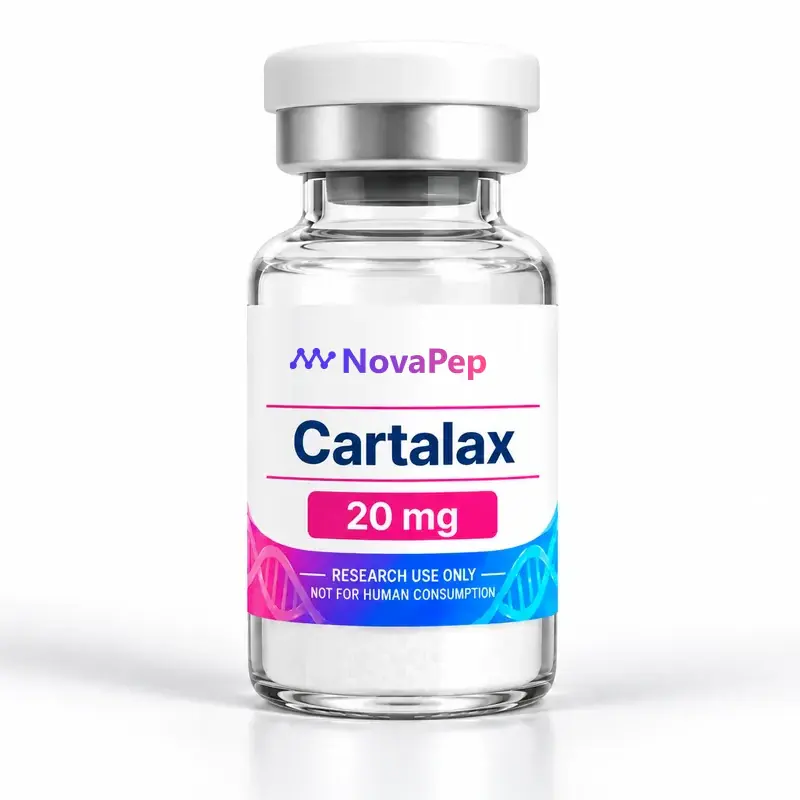
Each vial is white-capped with a pink and blue label and holds 20 mg of AED as a dry white cake. That is double the 10 mg found in Pinealon and similar bioregulator vials. With a mass near 333 g/mol, one vial contains about 60 micromoles of AED, plenty for a long series of chondrocyte or fibroblast plates.
Its tiny size is where analysis gets tricky, since another tripeptide of similar makeup could look much the same on HPLC by itself. That is why mass confirmation settles identity. Labs that run their own LC-MS check on delivery should expect the singly protonated ion close to 334 on the mass-to-charge axis.
Open the certificate and confirm three things. The measured mass should match 333.3 g/mol, the chromatogram should show a single dominant peak, and the stated purity should refer to your own lot number. Our COA library files each certificate under the lot code printed on the label, and the guide on how to read a COA explains each line in turn.
Let the closed vial reach room temperature, run the diluent slowly down the inside wall of the glass, and swirl softly until the liquid is clear. Adding 4 mL of bacteriostatic water to the 20 mg vial yields 5 mg/mL, and 2 mL yields a stronger 10 mg/mL stock. For any other volume, use the peptide calculator. The bigger fill suits labs that work from a strong master stock, drawing working aliquots without opening a fresh vial. Order Cartalax online in Australia and it travels by tracked Australia Post from our local stock.
Keep the unopened vial at -20 °C, dry and out of the light. After reconstitution, hold it at 2 to 8 °C and divide it into single-use portions so the stock is never warmed and cooled repeatedly. Label each tube with the concentration and the date, since that label links an aliquot back to its certificate months later.
The sequence of Epitalon is Ala-Glu-Asp-Gly, which makes Cartalax that same chain without the closing glycine. Even so, the two are researched in quite different settings, Epitalon in telomerase and pineal ageing work and Cartalax in chondrocytes and fibroblasts. Choose Cartalax for matrix and cartilage readouts, Epitalon for telomerase questions, and both to learn whether one added residue alters the outcome. With the only difference at the C-terminus, any divergence points straight to that glycine.
For a contrast among tissue repair tools, add BPC-157. It is a gastric peptide fragment of 15 residues with a wide soft tissue literature, sharing neither structure nor proposed mechanism with Cartalax.
You may also see Cartalax listed as AED, Ala-Glu-Asp, H-Ala-Glu-Asp-OH or L-alanyl-L-glutamyl-L-aspartic acid. Russian sources group it with the peptide bioregulators, at times called cytogens, and associate it with cartilage and connective tissue. Each of these labels refers to one and the same tripeptide, formula C12H19N3O8 and 333.3 g/mol. Certain catalogues simply call it AED peptide or a cartilage bioregulator, and the molecule supplied is identical.
So is Cartalax legal in Australia? As of October 2026 it does not appear by name in the Poisons Standard. When we reviewed the current instrument we found no listing for AED or Ala-Glu-Asp, meaning no schedule applies to it as a named substance. Being unscheduled does not make a peptide a therapeutic good, though. Any supply of a peptide for therapeutic use needs inclusion on the Australian Register of Therapeutic Goods, and the TGA has named unapproved peptide products as a compliance priority.
That is why researchers looking for Cartalax Australia supply find it in reagent catalogues and not through medical channels. NovaPep keeps Cartalax for sale in Australian stock and supplies it only as a laboratory research reagent, listed as a reagent and not a medicine. We accept orders from adults aged 18 or over, and the vial must never be used in people or animals. The supply terms are set out on our research use policy page.
There is a single size, the 20 mg vial, twice what most bioregulator vials hold. If a project will run over several months, order all the vials at the start so they leave from one lot under one certificate where stock permits. You will not find Cartalax at a shop counter. NovaPep trades online only and sends orders around Australia from local stock, with same-day dispatch when payment clears before 3pm on a business day. Regional transit times are on our delivery information page, which also covers labs ordering research peptides in Perth.
Cartalax is Ala-Glu-Asp, a short bioregulator from the St Petersburg research programme, linked with cartilage and connective tissue cells.
No receptor is known. Its developers propose it reaches the nucleus and engages chromatin, a hypothesis few outside teams have tested.
Investigated in cultured skin fibroblasts and chondrocytes for matrix gene expression and senescence markers, strictly within the laboratory.
Cartalax is AED and Epitalon is AEDG, so running both shows what one extra glycine does.
Keep the unopened vial at -20 °C. Once in solution, refrigerate at 2 to 8 °C in portions thawed only once.
Twice the standard bioregulator fill, from Australian stock, with mass spectrometry and HPLC results on a lot-matched certificate.
Cartalax is the defined synthetic tripeptide Ala-Glu-Asp, used as a reagent in connective tissue cell culture. Researchers use it to see whether a very short peptide changes ageing markers or matrix gene expression in cartilage cells. It is supplied for in vitro work only and never for use in humans or animals.
No receptor has been identified. Its developers propose that the tripeptide reaches the nucleus and interacts with chromatin, nudging tissue-specific gene activity in aged cells. That model comes mainly from one research network and has not been confirmed by independent laboratories.
Cartalax fits chondrocyte, fibroblast and matrix gene work, while Epitalon fits telomerase and pineal ageing models. Cartalax is simply Epitalon minus its last glycine, so ordering the pair delivers a clean structural comparison in a single parcel. Each ships dry from stock in Australia and requires a diluent.
It will. Mass spectrometry confirms the 333.3 g/mol mass of every lot and HPLC measures its purity, with the resulting certificate posted in our COA library. The lot code on your vial matches that certificate, so the documents correspond to the exact material in your hands.
Yes, when bought as a laboratory reagent. As of October 2026 the Poisons Standard does not name Cartalax, yet it is not an approved medicine and may not be supplied for therapeutic use in Australia. NovaPep stocks the 20 mg vial locally and sells it only to adults aged 18 or over for in vitro research, never for human or veterinary use.
Put the 20 mg vial in your cart on this page and check out. It leaves from Australian stock as a tracked parcel, and orders paid before 3pm on a business day are dispatched that day. Cartalax arrives as dry powder, so add bacteriostatic water to the same order if you need something to dissolve it in.