 NovaPep
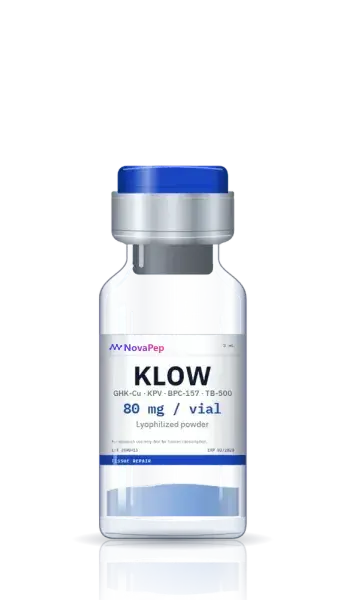
KLOW
80 mg vial
$139
Research use only. NovaPep supplies research-grade peptides for laboratory and in-vitro work only, not for human or veterinary use. By continuing you confirm you are 18 or older and ordering for research.
 NovaPep
In stock in Australia, batch certificate ready
Size: 1,500 mg vial
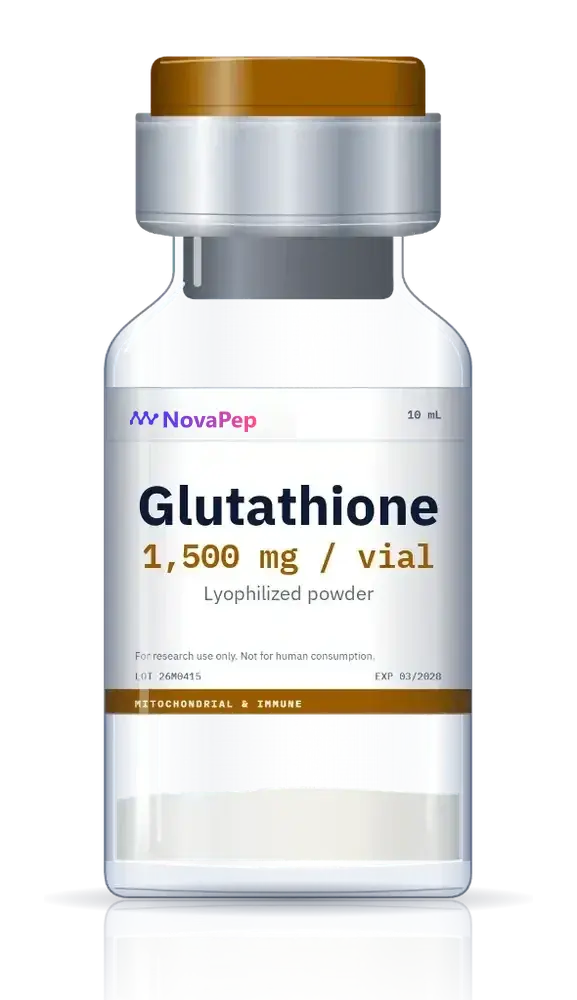
Buy glutathione online in Australia as a 1,500 mg research vial of reduced L-glutathione, tested for identity and purity on every lot. Glutathione, known as GSH, is the gamma-glutamyl-cysteinyl-glycine tripeptide that cells depend on as their chief small-molecule antioxidant. Labs use it as a substrate in glutathione peroxidase and transferase assays, as a redox standard and for melanocyte culture studies. Check the identity details before paying, which are C10H17N3O6S, 307.3 g/mol and CAS 70-18-8. Mass spectrometry confirms identity on every lot and HPLC measures purity, and that same trace shows how much has oxidised to GSSG. The lot certificate is online before checkout. For a metabolic partner compound, add NAD+ to the same order. No solvent is included, so dissolve weighed amounts in bacteriostatic water or your own assay buffer, and plan concentrations using the peptide calculator. Keep the unopened vial dry and dark at -20 °C. This research reagent is sold only to adults aged 18 and over.
For laboratory research use only. Not for human or veterinary use. Not TGA approved. See the NovaPep research use policy.
Glutathione is a small molecule of three amino acids that cells make for themselves and use as their primary chemical shield against oxidation. It donates electrons to harmful oxidants so that DNA, lipids and proteins are spared. The term glutathione peptide is correct, yet it is unlike most peptides in the way it is built, the way its residues join and the way cells transport it. Glutathione is for sale in Australia as a 1,500 mg research vial, ready to order online from local stock.
Frederick Gowland Hopkins at Cambridge named glutathione in 1921, and a hundred years later it is still one of the most frequently measured small molecules in biochemistry. Most peptides we stock copy sequences that cells produce on ribosomes, whereas glutathione is put together by two enzymes, which explains why its glutamate attaches to cysteine through a side chain. Our product is the reduced form as white powder, 1,500 mg in a single 10 mL vial, without any tablet binder, flavouring, liposome or capsule shell.
In 1888 the French researcher Joseph de Rey-Pailhade reported a sulfur-reducing material in yeast and called it philothion. Hopkins isolated it in 1921, though at first he described it as a pair of residues, glutamate and cysteine. Better purification in 1929 revealed glycine as a third residue, and in 1935 Harington and Mead confirmed the tripeptide sequence through chemical synthesis.
Glutathione is assembled in cells from glutamate, cysteine and glycine. What sets it apart is the gamma bond joining the first two residues through the side chain of glutamate, which shields it from normal peptidases and lets cells keep it at millimolar concentrations. The active site is the cysteine thiol, which passes electrons to reactive species and then links with a second molecule to give the oxidised disulfide GSSG. Two enzymes build it, glutamate-cysteine ligase and then glutathione synthetase, so depletion studies frequently combine the reagent with inhibitors of those steps.
Everything hinges on the sulfur atom of the cysteine. That thiol has a pKa near 9, so at neutral pH it is mostly protonated and less reactive, and enzymes like the glutathione S-transferases partly work by stripping that proton away. Levels differ sharply between compartments. The cytosol carries low millimolar amounts, plasma only micromolar ones, and mitochondria, which cannot synthesise their own, take it in from the cytosol. The endoplasmic reticulum stands apart, with a much more oxidised GSH to GSSG balance of between 1 to 1 and 3 to 1, as Hwang, Sinskey and Lodish reported in Science in 1992. That environment allows new proteins to form their disulfide bonds properly.
This chemistry supports a range of uses. Glutathione peroxidases and glutathione S-transferases both take reduced glutathione as substrate. The GSH to GSSG ratio is a routine marker of oxidative stress. Melanocyte culture work draws on it for tyrosinase and pigment pathway studies, and that is where a glutathione peptide for skin cell research belongs. You will find it listed as a reagent, not a medicine or supplement, among our longevity research peptides. Shop Glutathione online in Australia for this research, knowing each lot has been checked for identity and purity.
Uptake is the point most often misread in culture studies. Putting reduced glutathione into the medium will not dependably lift intracellular levels, since most cell types cannot take in the whole tripeptide. Enzymes on the surface cleave it and the cell then rebuilds it from the pieces. Groups that need higher intracellular glutathione generally use a cell-permeable ester like glutathione monoethyl ester, or the cysteine donor N-acetylcysteine, and reserve the free reagent for standards, enzyme assays and extracellular redox studies, where it behaves just as intended. Read our glutathione research guide for a deeper look at the GSH and GSSG cycle.
| Product name | Glutathione, reduced (GSH, L-glutathione) |
|---|---|
| Size | 1,500 mg in a 10 mL vial |
| Structure | gamma-L-glutamyl-L-cysteinyl-glycine, with glutamate linked through its side-chain carboxyl |
| Residues | 3 amino acids |
| Formula | C10H17N3O6S |
| Molecular weight | 307.3 g/mol |
| CAS | 70-18-8 |
| Presentation | White lyophilised powder in a clear 10 mL glass vial with an amber cap |
| Quality checks | Identity by mass spectrometry, with purity and the oxidised GSSG share by HPLC, certificate for each lot |
| In the box | One vial holding 1,500 mg of reduced glutathione, solvent not included |
| Storage conditions | -20 °C sealed, dark and dry, then 2 to 8 °C once dissolved |
| Stock status | In stock |
| Intended purpose | Laboratory in vitro research only |
This fill is sized for assays that use glutathione in milligrams, not micrograms. Each vial holds about 4.9 millimoles, so a single lot can support a lengthy series of plates.
Purity for a thiol reagent covers more than stray contaminants. Each certificate includes an HPLC trace that resolves reduced GSH from oxidised GSSG, showing how much of the powder is in the form your assay needs. Mass spectrometry confirms the parent at 307.3 g/mol, and the report notes the lot code and analysis date.
Because the oxidised dimer shows up close to 612.6 g/mol, a lot with notable GSSG also stands out clearly in the mass data. Check the lot in the certificate library before you order. Any lot that misses specification is never put on sale.
Since a vial contains much more than a single experiment needs, most labs weigh out what they need instead of dissolving the entire fill. For example, 100 mg in 2 mL of diluent gives 50 mg/mL. Use degassed buffer or water when you can, as dissolved oxygen hastens oxidation to GSSG, and rely on the dosing calculator for peptides for any other volume. Our guide to bacteriostatic and sterile water sets out which diluent suits each assay. Glutathione for sale in Australia leaves our shelves by tracked post, so it reaches your bench in good condition.
Keep the sealed vial dry at -20 °C, because the powder absorbs moisture each time the vial is opened. Store prepared solutions in small aliquots at 2 to 8 °C and use them within 28 days, although fresher solutions give cleaner redox baselines. Seal the vial firmly after each weighing and put it back in the freezer immediately.
Choose glutathione if your question is about conjugation reactions, peroxide removal or thiol redox buffering. Choose our NAD+ if it is about NAD-dependent enzymes, sirtuin activity or energy metabolism. NAD+ is a coenzyme rather than a peptide, and the two are often run together in oxidative stress designs.
Add SS-31 for a third angle when the focus is damage at the inner mitochondrial membrane. Every product has its own lot certificate, and pigmentation studies can explore our peptides for skin and hair research.
You will see this compound sold as glutathione, L-glutathione, reduced glutathione, GSH or gamma-L-glutamyl-L-cysteinylglycine, and older papers shorten the sequence to gamma-Glu-Cys-Gly. Glutathione disulfide, also called GSSG, is the oxidised form, a separate compound that this vial does not contain.
Associated redox terms include NADPH, thiol, glutathione reductase, glutathione peroxidase, glutathione S-transferase and the GSH to GSSG ratio. Every one of these names links back to reduced glutathione through CAS 70-18-8, and texts on sulfur metabolism cover it alongside methionine and cysteine.
We offer one 1,500 mg format because of how glutathione is consumed. Culture media and assays get through far more of it than they would a signalling peptide, so a small vial would be empty after only a few plates. A bigger fill needs more space, so it is packed in 10 mL glass rather than the 3 mL vials found throughout most of our range.
Order every vial a project requires at the same time so they come from one lot where stock permits and share a single certificate, which keeps redox baselines steady between runs. Groups doing enzyme kinetics frequently make a fresh standard daily, and with this large fill those daily weighings all draw on the same lot for weeks. We accept orders from adults aged 18 and over, who confirm their age at checkout.
This distinction matters because the glutathione that Australian shoppers find in chemists and health food stores is a different product category. Oral glutathione is permitted as an ingredient in listed complementary medicines, the tier marked with an AUST L number that reaches the ARTG once the sponsor certifies compliance rather than after a full TGA assessment. Such products can only carry low-level permitted claims, and the TGA has stated it has not assessed glutathione for skin lightening. Injectable glutathione is separate again. In a 2023 enforcement action about advertised intravenous infusions, the TGA called glutathione a prescription-only ingredient that may not be promoted to the public. Our guide to glutathione supplements covers the AUST L system more fully.
Is glutathione legal in Australia, then? As a listed medicine in tablets and capsules, yes, while injectable use falls under the prescription framework. Neither of those covers a bulk reagent-grade vial, so glutathione powder for assays is sourced from laboratory suppliers. Buy glutathione in Australia from NovaPep and the vial is shipped from local stock as a research chemical, ordered by adults 18 and over for in vitro use, and never for human or veterinary use.
NovaPep has no shopfront. You order glutathione online and it ships from Australian stock, leaving the same day for orders placed before 3pm on a business day, with tracked delivery to anywhere in the country.
Glutathione is a three-residue peptide carrying a reactive sulfur group that neutralises oxidants and supplies detoxifying enzymes.
Each order is a 10 mL vial with 1,500 mg of reduced glutathione. Solvent is not included, so add bacteriostatic water or prepare your own buffer.
Researchers rely on it as an enzyme substrate, a redox standard and in melanocyte culture studies, only ever as a lab reagent.
NAD+ is a coenzyme that runs energy metabolism, while glutathione mops up oxidants directly, and many studies track both.
Store the sealed vial at -20 °C and protect it from moisture. Glutathione in solution oxidises over time, so chill aliquots and use them quickly.
Every lot gets HPLC for purity and the oxidised GSSG share, plus mass spectrometry for identity. Find the certificates in the COA library.
Glutathione is a tripeptide of glutamate, cysteine and glycine that cells build with two enzymes, glutamate-cysteine ligase and glutathione synthetase. Its cysteine thiol passes electrons to oxidants, and two molecules then join as the disulfide GSSG. The vial holds the reduced form, GSH.
Asked another way, does glutathione peptide lighten skin in people? That question sits outside what a research reagent can answer. NovaPep makes no skin claims at all, because this vial is a laboratory reagent and not a medicine, supplement or cosmetic. In research, glutathione is used in melanocyte culture studies on tyrosinase and pigment pathways, with results measured in cells, not people. It is supplied for in vitro research only, to adults aged 18 and over.
The vial holds 1,500 mg, much more than the milligram amounts typical of research peptides, since assays consume glutathione in bulk as a substrate. A 3 mL vial would not fit that volume of powder with space to work, so it goes into 10 mL glass with an amber cap.
Yes. Each lot is checked by mass spectrometry for identity and HPLC for purity, and the HPLC result also gives the share of oxidised GSSG. You can find the report in the COA library under the lot code on your vial and read it before ordering.
Order glutathione for peroxidase and transferase assays, thiol redox buffering or GSH to GSSG measurement. Order NAD+ for NAD-dependent enzymes and energy metabolism. They address different aspects of oxidative stress, so plenty of projects buy both, and each comes with its own lot certificate.
Put the 1,500 mg vial in your cart from this page and go through checkout. It leaves Australian stock with dispatch on the same day when ordered before 3pm on a business day. There is no solvent in the box, so either add bacteriostatic water or make up your own buffer.
NovaPep
80 mg vial
 NovaPep
 NovaPep
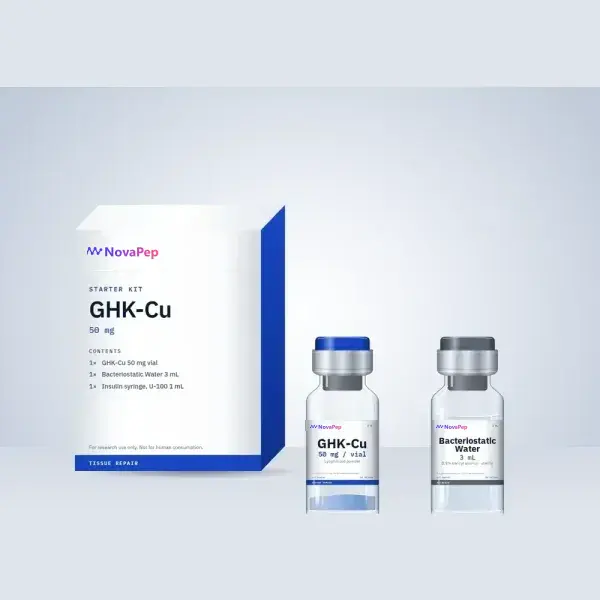
Kit
 NovaPep
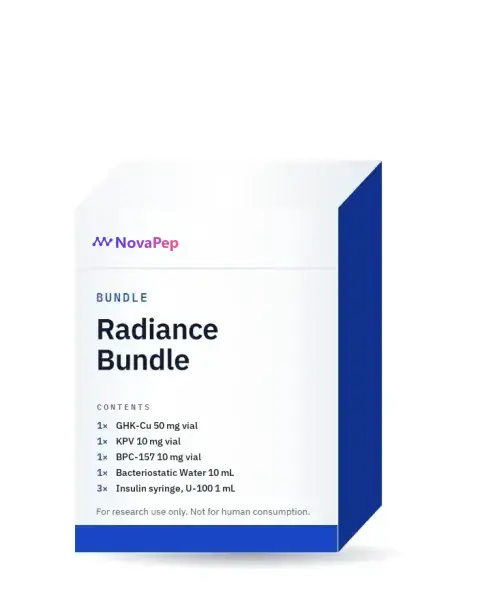
Bundle